The music of Come Home is an extraction from the second movement of my work "Fantasies for Viola and Piano." The music of that second movement is quite song-like, and in the summer of 2008 I decided to create a work for mezzo soprano and piano based on a section of the movement. Contrary to the viola work, which features additional contrasting material not used in the vocal arrangement, the song version is essentially in strophic form. After writing the song for mezzo soprano and piano, I thought that it would work well as a saxophone and piano duo. Thus, this version is a transcription of an arrangement of an original composition of mine.This performance with composer/saxophonist Steve Danyew and Ashley Morgan Garofalo on piano is a gem and worth listening to the full 8+ minutes. Congratulations are in order for Ashley, who starts her first college position at Fitchburg State College this fall. Ashley is also a blogger, and her music, poetry, arts [transcribed] should have a permanent place in your RSS subscriptions.
Monday, August 30, 2010
Steve Danyew's Come Home featuring Ashley Morgan Garofalo
Steve Danyew's Come Home for alto saxophone and piano actually started its life as a work for viola and piano. Steve writes:

Sunday, August 29, 2010
The Definitive Guide to Building and Maintaining a Repertoire List
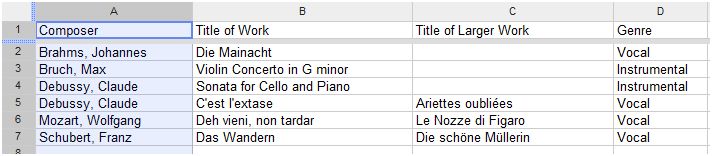
One of the most important things about being a collaborative pianist is developing depth of repertoire, whether you choose to specialize in one area or play a wide variety of genres. When you're applying for graduate school, a young artist program, or your first staff accompanist position, it's important to be able to present a complete repertoire list so those who are interested in you can get a better sense of the works, styles and genres that you've played so far.
The problem is that very few of us actively maintain a rep list and are able to keep track of what we've played over time. It takes a lot of time and regular updating to be able to offer a complete rep list (especially one as jaw-droppingly awesome as Amanda Johnston's) and this post will tell you how you can start, update, and offer one that will impress at hiring time.
Getting Started
Back in the old days, those of us diligent enough to be updating our rep lists did so on a weekly or monthly basis, when we would frantically search our books and photocopies, find out what was new, and add it to our list, most often a word document that lived on our home computer.
Fortunately, things have changed and the process of rep list-building can benefit greatly from the advances made with cloud computing technology. I recommend using a Google Docs spreadsheet for keeping the data in your rep list, and have created a template that you can use for this purpose:
Collaborative Pianist Repertoire List
You'll need to create and be signed into a Google account to save the template and start adding your own rep to the spreadsheet. The advantage of a Google Docs spreadsheet is that since it's stored on Google's servers, you can update it from any internet-enabled computer or smartphone. This is much more efficient than the old practice of having a word document on your hard drive that you only added to once in a blue moon.
Updating Your Rep List
Once you've saved the template to your Google account, you can start putting your repertoire on it. I've listed columns for composer, title of work, title of larger work (if applicable), genre, and sub-genre and added a few commonly known works to give you an idea of how the setup works. Here are some things to keep in mind when adding data to the fields:
- There is no need to insert rows. Simply add the latest data to the bottom of the spreadsheet, click on the arrows on the lettered columns, and choose "Sort Sheet A ---> Z" in order to alphabetize, ie. by composer.
- When listing composers, it's a good idea to put the last name first for the purpose of alphabetization.
- I've used the genre field for dividing between Instrumental and Vocal repertoire. You can also add Solo to this field.
- You can use the Sub-Genre field to even further segment your rep, ie. sonata vs. concerto, aria vs. art song.
Presenting Your Rep List
The time will come when you need to present your list in various elegant guises. Here are some ways that you can segment your full repertoire list in order to present it when the time comes:
- Select and copy any groups of fields and then paste and format them into a word document for official presentation. You can also paste them into WYSIWYG editors if you're building a website.
- For a complete alphabetical listing, sort the entire list alphabetically by composer.
- To divide into instrumental and vocal groups, sort the genre field, then the composer field, then copy and paste into a word document.
- To list a specialization such as violin concertos or lieder, sort the sub-genre field, then sort the composer field, then copy and paste the alphabetized contents of the chosen sub-genre field.
- For even more input, sorting, and presentation options, you can download the spreadsheet and then import it into a database program such as Microsoft Access or OpenOffice.org Base.
A couple of caveats
- Update your list regularly. Doing a mass update the night before you send out your DMA application is not a good idea. Setting up your list early as a Google spreadsheet and adding to it via smartphone or internet whenever you learn a work takes less time over the long term and results in a much better, flexible, and marketable product when you need it.
- Don't falsify the contents of your repertoire list. Only list the works that you actually can play. You're going to get burned if you pad your list. I recall a "cello specialist" I once worked with who only knew a few sonatas and no concertos. The best rep list in the world cannot mask a pianist with repertoire deficiencies. On the other hand, every single one of us has a slightly different specialization, the nuances of which can rise to the surface with a consistently revised list.
Although the template I created on Google Docs was intended for collaborative pianists, a few tweaks can make it work for any singer or instrumentalist.
Do you have any useful repertoire list and/or spreadsheet tips? If so, tell us about them in the comments.
Saturday, August 28, 2010
Andrew E. Simpson on Silent Movie Accompanying
The art of silent movie accompanying is alive and well - a recent Ryan Kearney article in TBDArts looks at the work of Andrew E. Simpson, who specializes in utilizing a variety of traditional and contemporary techniques to bring these silent classics to life. About his preparation process for the 1925 movie Maciste all'Inferno, recently screened at the National Gallery of Art in Washington:
It's a challenge, to say the least, because Simpson must play for an hour and a half straight, no breaks. "You have to pace yourself," he says. "The good thing is, most films have very few moments where there's outright action all the time. There's almost always a place where you can play a chord and settle, and the audience needs a break, too." And yet there are other films, Maciste being one of them, which are packed with action. "You look for opportunities to save yourself, so you're not exhausted, but with that film I did sort of leave it all out there," he says. "I have to tell you, this was one of the more exhausting performances I've done."
In this instance, at least, Simpson had the opportunity to watch Maciste beforehand. For many of his 50 or so performances since becoming an accompanist in 2006, he's gone into the screening cold, including when he plays the Slapticon festival in Arlington. (He also regularly plays the Library of Congress' Mt. Pony Theater in Culpeper, where he's the house accompanist.) "Often I play something I've never seen before, which is another special challenge because I have to anticipate what's happening," he says. "The more films you play, the easier it becomes to spot patterns, and it becomes a little easier to predict what will happen." For instance, if there's a vase prominently displayed in a scene, "you're pretty sure that vase is going to be broken at some point." And when the vase breaks, he's ready to replicate the sound of breaking china on the piano's upper register.
Picture of the Day

Thursday, August 26, 2010
Accompanist Needed by Sean Adams
This evening I found yet another accompanist poem, this time from McSweeney's realm of the bizarre and postmodern. An excerpt from Accompanist Needed by Sean Adams:
To build intrigue, the accompanist may be billed as an android, caveman, confirmed serial killer who is shortening his prison sentence through a musical community-service program, or all of the above. Therefore, it is necessary for the accompanist to play from music sheets of binary code, create music by striking the keys with an oversized faux-wooden club, and play with ankles and wrists cuffed.
Some of my singing engagements take place late at night, in the homes of strangers, without audiences or music, and may appear to be elaborate art or jewel heists. For engagements like this, the accompanist may be called on to pick locks, crack safes, break windows silently and jump over large, sometimes barb-wire topped fences with me riding piggy-back at all times.
The Hahn Piano Quintet
Most of us know Reynaldo Hahn's work through his exquisite songs, but what most people aren't aware of is the large body of chamber music that he wrote from 1891 through 1946. Here is the first movement of his 1921 Piano Quintet with pianist Benoit Zhou, joined by violinists Eva Zavaro and Aliisa Barrière, Antonin Le Faure on viola, and Mina Rodriguez on cello in this 2009 performance from the École Alsacienne.
Also check out James Chute's review of Cho Liang Lin and friends performing the quintet recently at SummerFest in San Diego.
Also check out James Chute's review of Cho Liang Lin and friends performing the quintet recently at SummerFest in San Diego.
Sunday, August 22, 2010
Flavio Ferri-Benedetti and Olgierd Bohuszewicz Perform Schumann
Zwielicht, Im Walde, and Frühlingsnacht from Liederkreis Op. 39 by Robert Schumann
Flavio Ferri-Benedetti, countertenor
Olgierd Bohuszewicz, piano
March 3, 2010 at the Elisabethen Kirche, Basel
Flavio Ferri-Benedetti, countertenor
Olgierd Bohuszewicz, piano
March 3, 2010 at the Elisabethen Kirche, Basel
Subscribe to:
Posts (Atom)