Pianists often ask me which arias the the most important ones to know in audition situations. Fortunately, the hard work and diligence of Kim Witman over the years has resulted in an invaluable resource: aria frequency lists from the Wolf Trap Opera audition tour! The most recent compilation contains the complete lists from 2010 through 2012, sorted by voice type, arias listed, first aria offered, and arias requested.
2010-12 Season Audition Tour Aria Frequency Lists
Showing posts with label Repertoire. Show all posts
Showing posts with label Repertoire. Show all posts
Monday, October 01, 2012

Sunday, August 29, 2010
The Definitive Guide to Building and Maintaining a Repertoire List
One of the most important things about being a collaborative pianist is developing depth of repertoire, whether you choose to specialize in one area or play a wide variety of genres. When you're applying for graduate school, a young artist program, or your first staff accompanist position, it's important to be able to present a complete repertoire list so those who are interested in you can get a better sense of the works, styles and genres that you've played so far.
The problem is that very few of us actively maintain a rep list and are able to keep track of what we've played over time. It takes a lot of time and regular updating to be able to offer a complete rep list (especially one as jaw-droppingly awesome as Amanda Johnston's) and this post will tell you how you can start, update, and offer one that will impress at hiring time.
Getting Started
Back in the old days, those of us diligent enough to be updating our rep lists did so on a weekly or monthly basis, when we would frantically search our books and photocopies, find out what was new, and add it to our list, most often a word document that lived on our home computer.
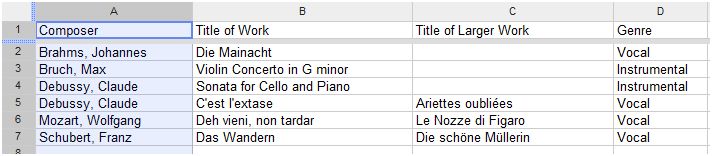
Fortunately, things have changed and the process of rep list-building can benefit greatly from the advances made with cloud computing technology. I recommend using a Google Docs spreadsheet for keeping the data in your rep list, and have created a template that you can use for this purpose:
Collaborative Pianist Repertoire List
You'll need to create and be signed into a Google account to save the template and start adding your own rep to the spreadsheet. The advantage of a Google Docs spreadsheet is that since it's stored on Google's servers, you can update it from any internet-enabled computer or smartphone. This is much more efficient than the old practice of having a word document on your hard drive that you only added to once in a blue moon.
Updating Your Rep List
Once you've saved the template to your Google account, you can start putting your repertoire on it. I've listed columns for composer, title of work, title of larger work (if applicable), genre, and sub-genre and added a few commonly known works to give you an idea of how the setup works. Here are some things to keep in mind when adding data to the fields:
- There is no need to insert rows. Simply add the latest data to the bottom of the spreadsheet, click on the arrows on the lettered columns, and choose "Sort Sheet A ---> Z" in order to alphabetize, ie. by composer.
- When listing composers, it's a good idea to put the last name first for the purpose of alphabetization.
- I've used the genre field for dividing between Instrumental and Vocal repertoire. You can also add Solo to this field.
- You can use the Sub-Genre field to even further segment your rep, ie. sonata vs. concerto, aria vs. art song.
Presenting Your Rep List
The time will come when you need to present your list in various elegant guises. Here are some ways that you can segment your full repertoire list in order to present it when the time comes:
- Select and copy any groups of fields and then paste and format them into a word document for official presentation. You can also paste them into WYSIWYG editors if you're building a website.
- For a complete alphabetical listing, sort the entire list alphabetically by composer.
- To divide into instrumental and vocal groups, sort the genre field, then the composer field, then copy and paste into a word document.
- To list a specialization such as violin concertos or lieder, sort the sub-genre field, then sort the composer field, then copy and paste the alphabetized contents of the chosen sub-genre field.
- For even more input, sorting, and presentation options, you can download the spreadsheet and then import it into a database program such as Microsoft Access or OpenOffice.org Base.
A couple of caveats
- Update your list regularly. Doing a mass update the night before you send out your DMA application is not a good idea. Setting up your list early as a Google spreadsheet and adding to it via smartphone or internet whenever you learn a work takes less time over the long term and results in a much better, flexible, and marketable product when you need it.
- Don't falsify the contents of your repertoire list. Only list the works that you actually can play. You're going to get burned if you pad your list. I recall a "cello specialist" I once worked with who only knew a few sonatas and no concertos. The best rep list in the world cannot mask a pianist with repertoire deficiencies. On the other hand, every single one of us has a slightly different specialization, the nuances of which can rise to the surface with a consistently revised list.
Although the template I created on Google Docs was intended for collaborative pianists, a few tweaks can make it work for any singer or instrumentalist.
Do you have any useful repertoire list and/or spreadsheet tips? If so, tell us about them in the comments.
Friday, April 18, 2008
Last Letter Home Available Through Classical Vocal Reprints
A big thanks to Josiah Gulden for leaving the following comment on a previous posting about the continuing search for places to purchase the score of Lee Hoiby's Last Letter Home for baritone and piano.
For those who don't haven't heard about Classical Vocal Reprints, they are a fine company that's been around a long time that specializes in out of print and hard to find vocal music. I did some checking and the piece is indeed available on page 39 of the 2008 CVR Catalog (warning: 10MB pdf file) with the following info:
Private First Class Jesse Givens (to the fallen in Iraq) Voice: BAR CVR#: 8023 Price: $10.00
What would I do without such great readers and commenters?
The voice/piano version of the piece is available under the title "Pfc. jesse Givens" through Classical Vocal Reprints.
For those who don't haven't heard about Classical Vocal Reprints, they are a fine company that's been around a long time that specializes in out of print and hard to find vocal music. I did some checking and the piece is indeed available on page 39 of the 2008 CVR Catalog (warning: 10MB pdf file) with the following info:
Private First Class Jesse Givens (to the fallen in Iraq) Voice: BAR CVR#: 8023 Price: $10.00
What would I do without such great readers and commenters?
Monday, April 14, 2008
More Info on Lee Hoiby's Last Letter Home
Many readers have expressed a great deal of interest in Lee Hoiby's Last Letter Home, a song based on a text by Pfc. Jesse Givens, a soldier in the US Army who perished in Iraq. I would like to express my thanks to Norman Ryan, Vice-President of Composers and Repertoire at Schott Music for sending word that Schott will indeed be publishing the version of Last Letter Home for voice and piano shortly. Norman also mentioned links to recent press releases with more info on the song:
Stay tuned for more info on the publication of the voice and piano version...
Lee Hoiby's Last Letter Home is the setting to music of a letter by US Army tank crewman, Jesse Givens, who had been in Iraq for just a month when, on May 1, 2003, his tank crashed and fell into a canal off the Euphrates River. The rest of the crew escaped through a hatch, but Givens perished trapped inside the tank. Hoiby's intention was to set Givens' words as clearly as possible, writing it in three-part form for one tenor and two baritone parts. Last Letter Home is also available in versions for solo baritone and piano as well as string quartet and orchestra.
Stay tuned for more info on the publication of the voice and piano version...
Wednesday, March 12, 2008
What's With the Three Suns in Die Nebensonnen?
 One of the most puzzling songs in Franz Schubert's Winterreise is the second from the end, Die Nebensonnen, in which the near-delusional and exhausted narrator sees not one, but three suns, and longs for darkness.
For those who have ever wondered what Schubert's Die Nebensonnen was all about, its explanation is much simpler and less symbolic than many people think. What the narrator in Die Nebensonnen is looking at is a Sundog, which is an optical phenomenon created by sunlight on ice crystals which forms a solar halo, several points of which are illuminated. You can read more about sundogs at the Wikipedia article on the subject. You can also find some more great sundog pictures and a video posted today on English Russia.
(Image is a Wikipedia Featured Picture by Erik Axdahl)
Thursday, May 31, 2007
15 Ways To Add 10-minute Practice Blocks To Your Routine
The power of 10
A recent article on LifeDev about getting work done in 10-minute increments got me thinking--can we pianists utilize a quick 10-minute practice session to get things done as well? From the article:
2. Warm up by jumping right to that passage that is making your life miserable.
3. Warm up by playing some piece or passage with the most beautiful sound you can summon. String players are known to do this. It works.
4. Sight read!
5. Review memorization for a piece or passage.
6. Review by ultra slow practicing a difficult passage.
7. Play a difficult passage in as many different ways interpretively as you can imagine.
8. Play a difficult passage with the left hand only.
9. Play a difficult passage with the right hand only.
10. Play a difficult passage in one hand with the other hand shadowing its part on your knee (a technique used by Kissin).
11. Visualize a passage, then play. Repeat.
12. Visualize a passage without doing any playing.
13. Play something in a completely different style from the rest of your repertoire. Known to restore sanity at difficult times of the year.
14. Play through repertoire related to what you're playing. For example, if you're playing Beethoven's Waldstein Sonata, play through the Andante Favori (the original second movement).
15. Do a cool-down. Slow technique, easy sight-reading, or a favorite passage are possibilities.
A few caveats
While I don't recommend practicing for only 10 minutes a day or for that matter in chunks of only 10 minutes, these types of power practice blocks can be very useful when used in conjunction with larger units, ie. 10 minutes + 1 hour + 45 minutes + 10 minutes. And do not under any circumstances use the absolute worst practice system ever, in which practice is only done during the commercials of a hockey game!
A recent article on LifeDev about getting work done in 10-minute increments got me thinking--can we pianists utilize a quick 10-minute practice session to get things done as well? From the article:
Oh, but 10 minutes… now that’s a tasty number. Not only will ten get you started, you’ll probably be finished too, if you focus. And focus is practically required with 10 minutes. It’s a small, focused amount of time.And if you’ve got five blocks of 10 minutes lying around in your day, that’s 50 minutes of highly-focused time. Compare that to a larger chunk of 50 minutes. That’s right, more time for procrastination. Small, focused, manageable bursts of productivity are much more effective than those flabby blocks of time.
How to make 10 minute practice blocks work
Here are some ideas I brainstormed on how it might be possible to integrate 10-minute windows into your practice and rehearsal day.
2. Warm up by jumping right to that passage that is making your life miserable.
3. Warm up by playing some piece or passage with the most beautiful sound you can summon. String players are known to do this. It works.
4. Sight read!
5. Review memorization for a piece or passage.
6. Review by ultra slow practicing a difficult passage.
7. Play a difficult passage in as many different ways interpretively as you can imagine.
8. Play a difficult passage with the left hand only.
9. Play a difficult passage with the right hand only.
10. Play a difficult passage in one hand with the other hand shadowing its part on your knee (a technique used by Kissin).
11. Visualize a passage, then play. Repeat.
12. Visualize a passage without doing any playing.
13. Play something in a completely different style from the rest of your repertoire. Known to restore sanity at difficult times of the year.
14. Play through repertoire related to what you're playing. For example, if you're playing Beethoven's Waldstein Sonata, play through the Andante Favori (the original second movement).
15. Do a cool-down. Slow technique, easy sight-reading, or a favorite passage are possibilities.
A few caveats
While I don't recommend practicing for only 10 minutes a day or for that matter in chunks of only 10 minutes, these types of power practice blocks can be very useful when used in conjunction with larger units, ie. 10 minutes + 1 hour + 45 minutes + 10 minutes. And do not under any circumstances use the absolute worst practice system ever, in which practice is only done during the commercials of a hockey game!
Thursday, December 29, 2005
Schubert DSM links
Since I have previously posted some Winterreise links, now is the time to do the same with Schubert's first song cycle, Die schöne Müllerin, although the online pickings are nowhere near as plentiful.
The best website on the subject is James Liu's Notes on Die schöne Müllerin, with complete texts and translations, info on composer and poet, recommended scores, recordings, and readings, all exhaustively hyperlinked. The only links from his site that don't go through are the online documentation at urtext.com, to which ordinary mortals do not have access. The William and Gayle Cook Music Library site of Indiana University has an online version of the Peters Edition.
The Schubert Institute UK has a complete Die schöne Müllerin discography, including pirated recordings, accurate to November 2005.
Also, here is a Schubert chronology by John Bruzas.
The best website on the subject is James Liu's Notes on Die schöne Müllerin, with complete texts and translations, info on composer and poet, recommended scores, recordings, and readings, all exhaustively hyperlinked. The only links from his site that don't go through are the online documentation at urtext.com, to which ordinary mortals do not have access. The William and Gayle Cook Music Library site of Indiana University has an online version of the Peters Edition.
The Schubert Institute UK has a complete Die schöne Müllerin discography, including pirated recordings, accurate to November 2005.
Also, here is a Schubert chronology by John Bruzas.
Saturday, December 17, 2005
New Off-site Resource Links
Here are a couple of new links added this evening to the permanent off-site resource section of the sidebar:
From Mostlywind, a link to a flute and piano repertoire list.
From the William and Gayle Cook Music Library of Indiana University Bloomington, a large listing of online musical scores in the public domain.
From Mostlywind, a link to a flute and piano repertoire list.
From the William and Gayle Cook Music Library of Indiana University Bloomington, a large listing of online musical scores in the public domain.
Subscribe to:
Posts (Atom)