For my students playing RCM piano examinations this June, this is the week that I spend nearly their entire lesson time doing a slow work-through of the entire technical requirements for their grade. In spite of the angry glances, groans of exasperation, and pleas for mercy, my students have been getting a clear understanding of where their strengths and weaknesses lie, as well as what work needs to be done by June in order for them to excel at their technical requirements.
Here are a few links for those inclined to spend some time perfecting their technical command of the instrument:
The 5 C's of Learning Piano Technique
5 Things to Remember About Fingerings
Build a Regular Practice Schedule Part 1
Build a Regular Practice Schedule Part 2
For those looking for a way to put it all together:
Find Your Muse, Find Your Process
Developing an Artistic Sensibility
Run the Program
Friday, February 29, 2008

Wednesday, February 27, 2008
Score-Reading Excerpt of the Day
Here's a world-sized score to play for your sight-reading enjoyment.
Tuesday, February 26, 2008
Recital with Rebecca Hass This Sunday in Orillia
 This Sunday, March 2, I will be performing with mezzo-soprano Rebecca Hass in her one-woman show, Wanna Sing a Show Tune, at the Orillia Opera House in Orillia, Ontario. Rebecca writes about the show, co-written with Michael Albano:
When Rebecca Hass dares to ask her audience “ Am I your first?” - She means opera singer. This 20 year veteran of the opera, concert and musical stage dishes on her public and private life in her one woman show “Wanna Sing a Showtune”.
With theatrical wit and savvy this multi faceted comedic writer and entertainer gives you a show filled with laughter and humanity as mom and opera singer meld into one. Despite having a career that has embraced Mozart, Bizet, Verdi and Wagner, in “Wanna Sing a Showtune’ this secret Broadway baby tells all through monologue and music from the likes of Cole Porter, George Gershwin and Stephen Sondheim. In this no holds barred show discover what on earth a Mezzo Soprano is, and why it stinks to be one. Travel the operatic heights of emotion as you experience the plight of our Mezzo-never to be diva-Soprano as well as find out the importance of the Car Show to ones nuptial opportunities.
We are taken on an autobiographical musical journey that not only entertains, but also reminds us to celebrate the special gifts and talents we each possess. An affirming evening of theatre that allows us to laugh, cry and, as we say in the theatre business, is shorter than “Cats”.
Sunday's performance is presented as part of the Orillia Concert Association, and has sold out on subscription, so no tickets will be available unless you've already purchased them!
Many of you might also know Rebecca as a blogger and author of The Resonant Life, which chronicles her recent move to Victoria and work as a life coach.
Speedlinking - 26 February 2008
Here are some interesting articles from the last few days:
- The New York Philharmonic's trip to North Korea is probably the most important classical music news story of this year. Miss Mussel has compiled an excellent roundup of the coverage this story has been getting in various media outlets.
- Now that the NY Phil has become the toast of Pyongyang, it's not surprising that there seems to be an outbreak of cultural evangelism fever. Jacob Stockinger asks the question of whether the time is right for the Madison Symphony Orchestra to bring classical music to Cuba. Perhaps someone should notify Mr. Stockinger that Cuba already has a thriving classical music scene and that nearly every country on the planet except the US already maintains economic and cultural relations with Cuba.
- Not sure yet that your love of teaching and performing is translating into financial gain? Liz Strauss has a list of 25 ways to love what you do so the money follows.
- Kiri te Kanawa has lashed out at classical crossover artists such as Charlotte Church and Hayley Westenra:
They are all fake singers, they sing with a microphone. These people, two or three years and they're gone. People call them up-and-coming, but they never last. They are the new fakes for the new generation.
Dame Kiri is correct, of course. Becoming a professional operatic singer able to sing above an orchestra requires over a decade of intense study. That didn't stop Paul Chapman in the Telegraph from taking a few swipes at her near the end of his article. - Can't bear to spend another hour in a practice room? Ben Clapton at the recently relaunched Music Practice Tips has a useful list of 10 useful things to do when you don't want to practice.
Monday, February 25, 2008
The Berlin Philharmonic Cello Challenge Online Game
Here's a great game for all those wannabe cellists: the Berlin Philharmonic's Cello Challenge. Use your mouse to follow the bow of a cellist playing Saint-Saëns' The Swan and learn a bit about bowspeed and direction in the process. I found that the thrill of staying on track and achieving a high score was only matched by the fun of making some truly dreadful scraping sounds when my mouse got off track with the bow. My highest score to date is 3725 3870--play and post your scores below.
(Via Musical Assumptions)
(Via Musical Assumptions)
Saturday, February 23, 2008
Piano Student Seriously Injured During Lesson
Christopher Rodriguez, a 10-year-old piano student in the middle of a lesson at the Harmony Road Music School in Oakland, was seriously injured when a shot fired from a robbery in progress at a nearby gas station penetrated the walls of the music school and hit him in the abdomen. Christopher is expected to be paralyzed from the waist down.
San Fransicso Chronicle article
CNN article
If you're interested in finding out more about this story, learning about the numerous fundraising concerts scheduled, or donating funds for his medical expenses, you can visit the blog set up by his family.
San Fransicso Chronicle article
CNN article
If you're interested in finding out more about this story, learning about the numerous fundraising concerts scheduled, or donating funds for his medical expenses, you can visit the blog set up by his family.
Friday, February 22, 2008
Classical Music...For the First Time
What would it be like to experience classical music for the first time if you had never had the chance to hear it live before? An article by Jade Witten in IOL reports on the experiences of the students of Inkwenkwezi Senior Secondary School in South Africa upon being visited by the Geneva Brass Quintet and hearing classical music for the first time:
You might want to look out for some of these students making a mark in the music world in the next 10-20 years...
"I can't believe they played our anthem and a song that we know, it was special to me. I feel excited. I would also like to play and travel the world like them," Khuthala Mgodini, 18, said.
Abulele Makubalo, 17, said she wanted her principal to introduce classical music at their school so that she could learn to play.
You might want to look out for some of these students making a mark in the music world in the next 10-20 years...

Pipe Dreams Redux
I received yet another round of the famous email hoax about the Animusic Pipe Dreams video this morning. For those of you that haven't heard of it yet, here's how the email reads:
Wrong, wrong, wrong. Evidence on Snopes.com proves that Pipe Dreams is really a computer-animated video from Animusic and that the corporate/educational collaboration never happened but may have been intended as a viral marketing ploy.
Anyway, it's still an amazing video:
Read this first before opening the video. Turn your sound up!
This is almost unbelievable. See how all of the balls wind up in catcher cones. This incredible machine was built as a collaborative effort between The Robert M. Trammell Music Conservatory and the Sharon Wick School of Engineering at the University of Iowa.
Amazingly, 97% of the machines components came from John Deere Industries and Irrigation Equipment of Bancroft, Iowa. Right first time - Farm Equipment!
It took the team a combined 13,029 hours of set-up, alignment, calibration, and tuning before filming this video but as you can see it was well worth the effort.
It is now on display in the Matthew Gerhard Alumni Hall at the University and is already slated to be donated to the Smithsonian.
Wrong, wrong, wrong. Evidence on Snopes.com proves that Pipe Dreams is really a computer-animated video from Animusic and that the corporate/educational collaboration never happened but may have been intended as a viral marketing ploy.
Anyway, it's still an amazing video:
Thursday, February 21, 2008
Public Domain Books on Piano Pedagogy
Natalie at Music Matters Blog has found a great list of books about pianos and piano playing in the public domain. Read them while they're still legal...
Bathroom Divas Clip from Season 1 on YouTube
This clip from the first season of Bathroom Divas recently showed up on YouTube. This excerpt is from the semi-final round held at Bloor Street United Church in Toronto. Chris Burton is at the piano.
The Piano Scarf on Steroids
Opera Chic has spotted a new take on the traditional piano scarf, via the collection of Frankie Morello.
A subsequent search on Flickr yielded an entire smorgasbord of piano scarves.
A subsequent search on Flickr yielded an entire smorgasbord of piano scarves.
Monday, February 18, 2008
Upended Piano in Detroit's Lee Plaza Ballroom
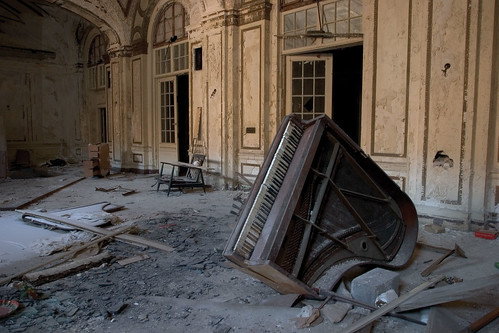 This desolate picture was taken in the ruins of the Lee Plaza Hotel ballroom in Detroit.
(Via jlehrler's photostream on Flickr)
You can also see different shots of the same piano here, here, here, and here.
Opera To Go 2008: The Colony
Many of us wage a constant battle against ants and other insects. But what if ants and humans were the same size? Lisa Codrington's libretto tells a humorous story of such an encounter, with colonial overtones...
The Colony
Libretto by Lisa Codrington
Music by Kevin Morse
Queen of the Amazon Ants (mezzo soprano)
Subject (soprano)
Herbert J. Hanson, Ant Exterminator (tenor)
Inside the ant colony, the queen interrogates the subject on the recent extermination of all the ants in the colony except themselves. After a meditation on the superiority and hardiness of Amazon ants, Herbert pushes a large piece of chocolate cake onto the stage, which the subject hungrily approaches. The queen realizes the ploy, and the two ants put on their gas masks and run for cover as Herbert sprays the immediate area with smoke. Herbert, laughing, exits as the two ants re-emerge and the queen orders the subject to bring Herbert to her so she can mate with him. Herbert re-enters, and after a short aria, is surprised by the subject, who subdues him after a heated battle. She then drags him off to the colony.
When Herbert regains consciousness, he finds himself tied to a chair. The queen introduces herself and after accusing him of exterminating nearly the entire colony, expresses her wish to mate with him. After a heated duet, Herbert turns to the subject and informs her that she not only has been stolen from a neighboring ant colony before she hatched, but that she is actually a carpenter ant, not an Amazon. After more heated argument, the queen informs Herbert that it is time to mate. Herbert buys some time by suggesting a mating dance, to which the queen reluctantly agrees. Herbert dances first, after which the queen takes her turn and then reclines upon the ground. Herbert siezes the opportunity and pins her down with his foot. The queen begs the subject to help her, but the subject refuses to come to her aid. Herbert then sprays the queen with an aerosol spray, and she falls to the ground. Herbert offers a truce with the subject, which she accepts, but before she can touch his outstretched hand, Herbert sprays the subject with a fatal dose of bugspray. Herbert triumphantly leaves the stage. The queen regains consciousness, sings of her determination to continue the fight against human domination, and leaves the stage in pursuit of Herbert.
You can read more about Lisa Codrington at Africlassical. Opera To Go 2008 is a presentation of Tapestry Opera Works and runs through February 23rd at the EnWave Theatre in Toronto as part of the Harbourfront Centre's World Stage 08.
The Colony
Libretto by Lisa Codrington
Music by Kevin Morse
Queen of the Amazon Ants (mezzo soprano)
Subject (soprano)
Herbert J. Hanson, Ant Exterminator (tenor)
Inside the ant colony, the queen interrogates the subject on the recent extermination of all the ants in the colony except themselves. After a meditation on the superiority and hardiness of Amazon ants, Herbert pushes a large piece of chocolate cake onto the stage, which the subject hungrily approaches. The queen realizes the ploy, and the two ants put on their gas masks and run for cover as Herbert sprays the immediate area with smoke. Herbert, laughing, exits as the two ants re-emerge and the queen orders the subject to bring Herbert to her so she can mate with him. Herbert re-enters, and after a short aria, is surprised by the subject, who subdues him after a heated battle. She then drags him off to the colony.
When Herbert regains consciousness, he finds himself tied to a chair. The queen introduces herself and after accusing him of exterminating nearly the entire colony, expresses her wish to mate with him. After a heated duet, Herbert turns to the subject and informs her that she not only has been stolen from a neighboring ant colony before she hatched, but that she is actually a carpenter ant, not an Amazon. After more heated argument, the queen informs Herbert that it is time to mate. Herbert buys some time by suggesting a mating dance, to which the queen reluctantly agrees. Herbert dances first, after which the queen takes her turn and then reclines upon the ground. Herbert siezes the opportunity and pins her down with his foot. The queen begs the subject to help her, but the subject refuses to come to her aid. Herbert then sprays the queen with an aerosol spray, and she falls to the ground. Herbert offers a truce with the subject, which she accepts, but before she can touch his outstretched hand, Herbert sprays the subject with a fatal dose of bugspray. Herbert triumphantly leaves the stage. The queen regains consciousness, sings of her determination to continue the fight against human domination, and leaves the stage in pursuit of Herbert.
You can read more about Lisa Codrington at Africlassical. Opera To Go 2008 is a presentation of Tapestry Opera Works and runs through February 23rd at the EnWave Theatre in Toronto as part of the Harbourfront Centre's World Stage 08.
Some New Features in the Sidebar and Footer Sections
A few days ago while browsing Blogger in Draft, I chanced upon a new widget in development called Blog List that allows you to load a large number of sites that can then be displayed in various orders. After a bit of experimentation (and loading most of the blogs on Scott Spiegelberg's Top 50 Technorati list), I finally came up with "Hot Stories in the Classical Blogosphere", which allows you to see the 10 most recently updated blogs taken from a pool of 69 classical music blogs. You can see the new widget in action near the bottom of the left-hand sidebar just above the archives.
Also recently new in the footer section is a Recent Comments widget, as well as news feeds from Google News that track the most recent stories in the subjects of classical music, piano, opera, chamber music, and collaborative piano. The list of my fave classical music blogs is now at the center of the footer section. Happy exploring!
Also recently new in the footer section is a Recent Comments widget, as well as news feeds from Google News that track the most recent stories in the subjects of classical music, piano, opera, chamber music, and collaborative piano. The list of my fave classical music blogs is now at the center of the footer section. Happy exploring!
Opera To Go 2008: The Translator
Of all the OTG operas, this one was the most challenging, both in its subject matter and the level of accuracy required of the singers. Kudos to Carla, Jess, Keith, and Calvin for adjusting so quickly and with great vocal precision to an unfamiliar electronic style that packs a huge emotional punch in an opera that goes to a place most of us would rather not think about.
The Translator
Libretto by Leanna Brodie
Music By David Ogborn
Video by Jarek Obsadny
Alessandra Jensen (mezzo soprano)
Crane (baritone)
Man (soprano)
Woman (tenor)
This work is written for voices and live electronics controlled via laptop by David Ogborn.
At a CIA black site, Alessandra Jensen translates the words of suspected terrorists from Pashtun to English as they are tortured by US forces in order to obtain information. At the beginning of the opera, she is translating a male teenager in obvious distress (offstage, recorded voices). She then watches a group of men pleading for mercy as they are being waterboarded (also via recorded voices offstage). She videotapes the scene with her cellphone and posts it to the internet. A radio announcer states that the White House has declared that the footage, which shows the torture and even possible death of detainees at the hands of US forces, is a hoax.
Alessandra is next seen being lectured by Crane, an officer, about the morally ambiguous world she is forced to inhabit. Crane makes the case that the US is merely trying to win the war, and if they need to bend the rules of engagement, so be it. Alessandra interjects that she has just watched a child die, chanting the poetry of Rahman Baba as he suffered. She rejects his world-view and is sent back to her quarters, where she is visited by a Man and a Woman, representing ordinary Americans who talk to her about fear, the desire for security, manifest destiny, the disappearance of jobs and health care, rising debt, etc. Alessandra is tormented by these voices and eventually decides to commit suicide by hanging while her cellphone is videotaping. As she walks offstage to her doom, a radio voice states that a spokesman for the White House has declared that the videotape of Alessandra Jensen hanging herself is a hoax.
Opera To Go 2008 runs through February 23rd at the EnWave Theatre in Toronto as part of the Harbourfront Centre's World Stage 08.
The Translator
Libretto by Leanna Brodie
Music By David Ogborn
Video by Jarek Obsadny
Alessandra Jensen (mezzo soprano)
Crane (baritone)
Man (soprano)
Woman (tenor)
This work is written for voices and live electronics controlled via laptop by David Ogborn.
At a CIA black site, Alessandra Jensen translates the words of suspected terrorists from Pashtun to English as they are tortured by US forces in order to obtain information. At the beginning of the opera, she is translating a male teenager in obvious distress (offstage, recorded voices). She then watches a group of men pleading for mercy as they are being waterboarded (also via recorded voices offstage). She videotapes the scene with her cellphone and posts it to the internet. A radio announcer states that the White House has declared that the footage, which shows the torture and even possible death of detainees at the hands of US forces, is a hoax.
Alessandra is next seen being lectured by Crane, an officer, about the morally ambiguous world she is forced to inhabit. Crane makes the case that the US is merely trying to win the war, and if they need to bend the rules of engagement, so be it. Alessandra interjects that she has just watched a child die, chanting the poetry of Rahman Baba as he suffered. She rejects his world-view and is sent back to her quarters, where she is visited by a Man and a Woman, representing ordinary Americans who talk to her about fear, the desire for security, manifest destiny, the disappearance of jobs and health care, rising debt, etc. Alessandra is tormented by these voices and eventually decides to commit suicide by hanging while her cellphone is videotaping. As she walks offstage to her doom, a radio voice states that a spokesman for the White House has declared that the videotape of Alessandra Jensen hanging herself is a hoax.
Opera To Go 2008 runs through February 23rd at the EnWave Theatre in Toronto as part of the Harbourfront Centre's World Stage 08.
Sunday, February 17, 2008
YouTube of The Dresden Dolls' Coin-Operated Boy
One of my piano students recently introduced me to the music of the Dresden Dolls, a goth Brechtian punk cabaret duo whose music is very much influenced by the world of Kurt Weill, the Weimar cabaret, and its recent successor, dark cabaret. Here they are in Coin-Operated Boy, a heavily piano-flavored song that is by turns post-Weillesque, pop, and punk.
  | The Dresden Dolls Companion (Piano/Vocal/Guitar) By The Dresden Dolls. Piano/Vocal/Chords Songbook (Arrangements for piano and voice with guitar chords). 192 pages. Published by Cherry Lane Music. (2500915) See more info... |
Opera To Go 2008: She sees her lover in the light of morning
A story about an unexpected encounter and innocence rediscovered...
She sees her lover in the light of morning
Libretto by Leanna Brodie
Music by Craig Galbraith
Characters:
Agnieska (soprano)
Sumana (mezzo soprano)
Scene 1. Agnieska, a thirty-something graduate student, brings Sumana, a much younger undergraduate, back to her apartment after having met in a bar. Sumana energetically admires the book-filled apartment, while Agnieska remains silent. While Sumana is in the bathroom, talking constantly, Agnieska finally breaks her silence and sings the names of her former lovers, all of whom she parted from on bad terms. When Sumana returns, Agnieska is reluctant to make any advances on Sumana, fully aware of what the consequences of her past relationships have been, but Sumana finally convinces her of how important this moment is to her, and they kiss.
Scene 2. The next morning. Sumana is still asleep and Agnieska returns, having left to make coffee. Agnieska sings an aria about how Sumana has brought her happiness, although unaware yet of just how painful love can be. Sumana wakes, and the two sing a duet, at the end of which the two are moved to laughter, and collapse into each other's arms.
Opera To Go 2008 runs through February 23rd at the EnWave Theatre in Toronto as part of the Harbourfront Centre's World Stage 08.
She sees her lover in the light of morning
Libretto by Leanna Brodie
Music by Craig Galbraith
Characters:
Agnieska (soprano)
Sumana (mezzo soprano)
Scene 1. Agnieska, a thirty-something graduate student, brings Sumana, a much younger undergraduate, back to her apartment after having met in a bar. Sumana energetically admires the book-filled apartment, while Agnieska remains silent. While Sumana is in the bathroom, talking constantly, Agnieska finally breaks her silence and sings the names of her former lovers, all of whom she parted from on bad terms. When Sumana returns, Agnieska is reluctant to make any advances on Sumana, fully aware of what the consequences of her past relationships have been, but Sumana finally convinces her of how important this moment is to her, and they kiss.
Scene 2. The next morning. Sumana is still asleep and Agnieska returns, having left to make coffee. Agnieska sings an aria about how Sumana has brought her happiness, although unaware yet of just how painful love can be. Sumana wakes, and the two sing a duet, at the end of which the two are moved to laughter, and collapse into each other's arms.
Opera To Go 2008 runs through February 23rd at the EnWave Theatre in Toronto as part of the Harbourfront Centre's World Stage 08.
Opera To Go 2008: The Shaman's Tale
Over the next few days, I'll be writing about each of the 7 operas featured on Tapestry New Opera Works' Opera To Go 2008...
The Shaman's Tale
Libretto by Krista Dalby
Composed by Kevin Morse
Characters:
The Shaman (baritone)
Woman (soprano)
Man (tenor)
The Shaman enters and tells the story of a man and a woman that tried to have a child but were unsuccessful. The Man and Woman enter (operating large puppets) and tell the Shaman that they will do anything in order to have a child. The Shaman replies that they must travel to the ocean and retrieve the great pearl at the bottom of the ocean. The Man and Woman bow to the Shaman and leave. As they make their journey to the sea, they discover the beauty of the world and are welcomed by farmers in the towns they travel through. Finally, they reach the sea. The Man dives into the ocean, retrieves the pearl, and returns to the surface. When he presents the pearl to the Woman, she realizes that the pearl was in fact a stopper for the ocean, which has begun to drain, which would cause all the fish, people, and plants that depend on it to die. She grabs the pearl, dives into the ocean, and replaces the pearl. Distraught, the Man weeps. The Man and Woman then exit for their journey home. The Shaman takes up the story and tells of how they remembered this story for the rest of their lives, and whenever they grew sad, "they thought of the sea and knew it was a small price to pay."
Much of the action of this story is told through puppets. The Woman and Man operate 12-foot-high puppets as they sing the roles. In addition, there is a screen at the centre of the stage behind which shadow puppets act out other parts of the action, such as the journey to the sea and the underwater sequences. Check out the Tapestry blog for pictures of the making of the puppets by Clay and Paper Theatre.
Opera To Go 2008 runs through February 23rd at the EnWave Theatre in Toronto as part of the Harbourfront Centre's World Stage 08.
The Shaman's Tale
Libretto by Krista Dalby
Composed by Kevin Morse
Characters:
The Shaman (baritone)
Woman (soprano)
Man (tenor)
The Shaman enters and tells the story of a man and a woman that tried to have a child but were unsuccessful. The Man and Woman enter (operating large puppets) and tell the Shaman that they will do anything in order to have a child. The Shaman replies that they must travel to the ocean and retrieve the great pearl at the bottom of the ocean. The Man and Woman bow to the Shaman and leave. As they make their journey to the sea, they discover the beauty of the world and are welcomed by farmers in the towns they travel through. Finally, they reach the sea. The Man dives into the ocean, retrieves the pearl, and returns to the surface. When he presents the pearl to the Woman, she realizes that the pearl was in fact a stopper for the ocean, which has begun to drain, which would cause all the fish, people, and plants that depend on it to die. She grabs the pearl, dives into the ocean, and replaces the pearl. Distraught, the Man weeps. The Man and Woman then exit for their journey home. The Shaman takes up the story and tells of how they remembered this story for the rest of their lives, and whenever they grew sad, "they thought of the sea and knew it was a small price to pay."
Much of the action of this story is told through puppets. The Woman and Man operate 12-foot-high puppets as they sing the roles. In addition, there is a screen at the centre of the stage behind which shadow puppets act out other parts of the action, such as the journey to the sea and the underwater sequences. Check out the Tapestry blog for pictures of the making of the puppets by Clay and Paper Theatre.
Opera To Go 2008 runs through February 23rd at the EnWave Theatre in Toronto as part of the Harbourfront Centre's World Stage 08.
More Degree Programs Added
I've added a number of schools to the list of Degree Programs in Collaborative Piano, gleaned from an update on the Collaborative Pianists Facebook group. Among the new additions:
The really difficult questions that I've been asked but haven't ventured into yet:
- Hong Kong Academy of the Arts
- Mannes College
- National Taiwan Normal University
- University of Ohio
- Royal Irish Academy of Music
- Royal Welsh College of Music and Drama
- Texas Tech University
- Universität für Musik und Darstellende Kunst Wien
The really difficult questions that I've been asked but haven't ventured into yet:
- What are the first, second, and third tiers of CP programs?
- With so many graduates of these programs (especially in the US), what are they doing after graduation and why is it still so difficult to find a pianist in many freelance markets?
Friday, February 15, 2008
One Busy Week
With all the busy schedule of tech week for Opera To Go, I've hardly had any computer time except to reply to email and Facebook messages. After OTG's official opening tonight, I hope to have a bit more time to write about the seven ambitious one-act operas on the program. Wish us luck tonight!
Sunday, February 10, 2008
Stephen Scott and the Art of the Bowed Piano
For three decades, composer Stephen Scott has been writing music for the sonic possibilities of the inside of a piano. A recent article and documentary on NPR Music highlights the compositional toolbox of this medium with some amazing footage. Here's the bowed piano ensemble in action playing Scott's Entrada:
(Via David Pescovitz)
(Via David Pescovitz)
Saturday, February 09, 2008
Those Overactive Pianists
An recent article by Bernard Holland in the NY Times highlights the growing problem of pianists who move around too much. Is it showmanship or self-aggrandizement? Kate Boyd in Notes from the Ivory Tower writes about her own observation of this phenomenon, and suggests some strategies for increasing efficiency of movement at the piano. Here are two of her suggestions:
- Slow-motion practicing, focusing on maximum economy of motion between every note in a passage
- Breathing from your diaphragm and centering yourself before beginning a phrase or section while practicing
Friday, February 08, 2008
DEAD Serious Feb. 29 in Vancouver......at a Crematorium
 Looking for something decidedly un-romantic to do this Valentine's Day? If you're in Vancouver
 Emotional weight and societal strictures make death a fertile field for art, the medium that allows us to speak the unspeakable. A kind of "anti-Valentine", DEAD Serious tackles this most profound, yet taboo, subject – our own mortality – through a musical (and literal) procession: from fear and fascination, to acceptance and peace, with stops at murder, black humour, sex, and survivors along the way. Acclaimed musicians Rachel Kiyo Iwaasa (piano) and Heather Pawsey (soprano) dig into mirthful and macabre music in an array of works by Canadian and international composers (Leila Lustig, David McIntyre, Jeffrey Ryan, Rodney Sharman, Gabriel Fauré, John Harbison and Francis Poulenc, among others) – plus world premieres by Canadian composers Chris Sivak and Robert Ursan – in this funereal, yet funny, foray. A performance space installation by noted artist S.D. Holman will extend meditations on mortality with photo-based artwork and an interactive altar to which audience members are invited to add their own mementos of their dead.
DEAD Serious is presented as part of the Vancouver 2010 Cultural Olympiad as well as the Canadian Music Centre's New Music in New Places program. The concert will begin at the Vancouver Crematorium, move through Mountain View Cemetery, and finish at the Hamilton -Harron Funeral Home. Admission is free, although you'll need to reserve tickets in advance (604-325-7441), since most funeral facilities already tend to be crowded venues....
(Image Credit: Ascension by S.D. Holman)
Update: DEAD Serious, originally scheduled for February 15, has now been rescheduled for February 29th at the same venue. All tickets for the 15th will automatically be transferred to the list for the 29th.
Thursday, February 07, 2008
Hundreds of Classical Music Radio Stations on Classical dj
So you're listening to your favorite classical radio station on the internet and all of a sudden they play Finlandia, again. You have to find another classical radio stream to refresh your ears and get your fix, but don't know where to go. What to do? You could always take your chances with a Google search, but far better is a dedicated classical music radio aggregator site such as Classical dj, with literally hundreds of classical choices from North and South America, Europe, Asia, the Pacific, and Africa. Most of the links to various stations have a short description, so you're not clicking blindly trying to find that ideal classical stream. Some of the hard-to-find classical stations I found on Classical dj:
- HJCK Bogota (Columbia)
- 4MBS Classic Radio Brisbane (Australia)
- KBS Seoul (S. Korea)
- Classic FM 102.7 Braamfontein (South Africa)
Wednesday, February 06, 2008
Let It Snow
After getting up at 6am to shovel some pretty dense and hard-packed snow, I took an early train (weather-delayed only 25 minutes) to the RCM for a morning meeting, then a day of teaching, my only this week at the RCM. This evening, as soon as I got back (only delayed 5 minutes--gotta love transit) I had another 10pm snow-shoveling session. The snow is really coming down now, so when I get up tomorrow morning, I'll have yet another half-hour of contemplative shoveling to do before heading out to the Distillery for a full day in rehearsal. I'll be writing more about Opera To Go and its 7 one-act operas in the next few days, but for now, I'm packing it in for the night.
Monday, February 04, 2008
Classical Music Bloggers are Macs, Traditional Media are PCs
I had an interesting conversation at a house concert in Toronto just over a year ago. A man I was talking to that evening bemoaned the fact that Toronto only has one opera company. Excuse me? Only one opera company? Exasperated, I asked him what made him come to that conclusion, to which he replied that from listening to the radio and reading the Toronto papers, the only opera company he ever heard about was the Canadian Opera Company and wished that there were others. Still stupefied, I informed him that he was completely mistaken and that there were in fact over a dozen companies in town (in fact, there are at least 17 in the Greater Toronto area at present). He still didn't believe me. To give the papers their due, writers who work for the Globe and Mail, National Post, and Toronto Star do mention the smaller opera companies from time to time and review their work, but on an occasional basis compared to their regular coverage of large organizations such as the Toronto Symphony and Canadian Opera Company. (It must also be mentioned that The WholeNote Magazine does chronicle the entire classical scene in Toronto to its farthest reaches, although this type of magazine is a rarity in North America.)
You find a similar situation with radio stations and television, although classical radio generally has a much better record of broadcasting a wide variety of artists and works, with special kudos given to the CBC Radio 2, BBC Radio 3, numerous European radio services and NPR stations. Still, radio's scope is limited to classical artists that are recorded, and by its nature usually ignore segments of the classical music world that aren't represented by recordings. Classical music is featured even less on television, given the economic realities of the medium (although cameo appearances often work in the format, such as my recent interview for CBC television). And what always looms over radio and television coverage is the ever-present specter of cutbacks and cancellations.
But how does one measure success and prominence in the classical world? Shall we celebrate only a few prominent soloists and ensembles, or chronicle the masses of music educators, orchestral musicians, chamber players, soloists, university students, amateurs, professionals, and administrators that make up the bulk of the classical music world and toil in the mines far from the star-making gaze of newspapers, television, and radio stations.
But take a look at a few classical music blogs and you'll find a completely different scene, with plenty of composers, artists, companies you've never heard of, new and exciting projects, a sophisticated level of discourse, and an exciting community far from the stuffiness classical music is supposed to embody. Part of the promise of classical music blogging lies in the following limitation of traditional media:
Except for a few major newspapers, traditional news media only report on a very small segment of the classical music scene, targeted towards the media outlet's demographic, and fit into the space alloted by editors and producers.
Classical music blogs have no such restrictions, are only limited by the vision of their authors, and aren't subject to restrictions of space and economics. They are not limited by utilizing a sole medium (words), since a classical music blogger can easily expand the range of the medium through offering podcasts, online downloads, traditional books, ebooks, or even radio programs in addition to their core blog. In fact, there are huge chunks of the classical music world and its stories that literally never got their due until these types of blogs came along:
I'll be the first to admit that no media outlet is ever completely neutral--every single writer has their agenda, their issues, and plays favorites. But the classical music blogosphere seems to have a more interesting cast of players, a wider scope of activities, no publication deadlines, creates their own demographics and rules, sets their own agenda, and does it with a passion that is bringing in a surprisingly large number of new readers every month (click on the Sitemeter stats of a few blogs in case you disagree).
The impact of classical music blogging is still being created and I still feel that nobody has yet chronicled what the medium can actually do, but 2008 already feels like the year in which classical music bloggers are starting to get their cred. So load up your Bloglines, Google Reader, or NewsGator account with your favorites, get connected to a part of the music world that's actually growing, and hopefully you'll enjoy what you hear.
You find a similar situation with radio stations and television, although classical radio generally has a much better record of broadcasting a wide variety of artists and works, with special kudos given to the CBC Radio 2, BBC Radio 3, numerous European radio services and NPR stations. Still, radio's scope is limited to classical artists that are recorded, and by its nature usually ignore segments of the classical music world that aren't represented by recordings. Classical music is featured even less on television, given the economic realities of the medium (although cameo appearances often work in the format, such as my recent interview for CBC television). And what always looms over radio and television coverage is the ever-present specter of cutbacks and cancellations.
But how does one measure success and prominence in the classical world? Shall we celebrate only a few prominent soloists and ensembles, or chronicle the masses of music educators, orchestral musicians, chamber players, soloists, university students, amateurs, professionals, and administrators that make up the bulk of the classical music world and toil in the mines far from the star-making gaze of newspapers, television, and radio stations.
But take a look at a few classical music blogs and you'll find a completely different scene, with plenty of composers, artists, companies you've never heard of, new and exciting projects, a sophisticated level of discourse, and an exciting community far from the stuffiness classical music is supposed to embody. Part of the promise of classical music blogging lies in the following limitation of traditional media:
Except for a few major newspapers, traditional news media only report on a very small segment of the classical music scene, targeted towards the media outlet's demographic, and fit into the space alloted by editors and producers.
Classical music blogs have no such restrictions, are only limited by the vision of their authors, and aren't subject to restrictions of space and economics. They are not limited by utilizing a sole medium (words), since a classical music blogger can easily expand the range of the medium through offering podcasts, online downloads, traditional books, ebooks, or even radio programs in addition to their core blog. In fact, there are huge chunks of the classical music world and its stories that literally never got their due until these types of blogs came along:
- Africlassical - the major contributions to the classical music world from the African diaspora.
- The Concert - written by soprano Anne-Carolyn Bird, and follows her career from graduate school to the Met and beyond.
- Opera Chic - the scandal-filled world of the opera scene and its larger-than-life players.
- On an Overgrown Path - the nooks and crannies of a wondrously diverse classical music culture
- Wolf Trap Opera - the inner workings of a vibrant opera company chronicled from the drawing board until opening night.
- Oboeinsight and Jason Heath's Double Bass Blog - instrumental niches that are usually not given their due, but in fact yield a vast wealth of insight into the art and industry of classical music (in addition to being uber-cool places to hang out).
I'll be the first to admit that no media outlet is ever completely neutral--every single writer has their agenda, their issues, and plays favorites. But the classical music blogosphere seems to have a more interesting cast of players, a wider scope of activities, no publication deadlines, creates their own demographics and rules, sets their own agenda, and does it with a passion that is bringing in a surprisingly large number of new readers every month (click on the Sitemeter stats of a few blogs in case you disagree).
The impact of classical music blogging is still being created and I still feel that nobody has yet chronicled what the medium can actually do, but 2008 already feels like the year in which classical music bloggers are starting to get their cred. So load up your Bloglines, Google Reader, or NewsGator account with your favorites, get connected to a part of the music world that's actually growing, and hopefully you'll enjoy what you hear.
Saturday, February 02, 2008
African Chamber Music Program from Vancouver New Music in March 2000
 Every so often, I'm privileged to play a concert that resonates with me for years afterwards. One of these took place in early March of 2000, in a concert for Vancouver New Music entitled "The Wanderer: Chamber Music of Africa". The online program info for the concert is either inaccessible to search engines or has been removed over time. Nevertheless, I still have the concert program, and following are the works and performers from that evening (I've added hyperlinks to the composers' biographical info).
[Program design note: the front cover of the program featured the 3 of Wands card from the Rider-Waite Tarot deck, pictured at left]
The Wanderer
Vancouver New Music
March 5, 2000
Vancouver East Cultural Centre
This concert featured special guest composers Akin Euba and Gyimah Labi [Euba was unable to attend for some reason, but Gyimah Labi worked extensively with the performers and was the evening's master of ceremonies]
The Wanderer (1960) by Akin Euba
Sue Round, cello
Christopher Foley, piano
Four Nigerian Dances (1976) by Joshua Ozoigwe
Christopher Foley, piano
At the Immaculate Beehive (1982/98) by Gyimah Labi
Victor Costanzi, violin
Mary Sokol Brown, violin
Andrew Brown, viola
Sue Round, cello
--
Intermission
--
String Quartet No. 2 'Hunting:Gathering" (1987) by Kevin Volans
(same quartet as above)
Tre Toccate per Pianoforte, 3rd movement (1987) by Malcolm Forsyth
Christopher Foley, piano
Antubam (1965) by J.H. Kwabena Nketia
Sue Round, cello
Christopher Foley, piano
Ancient Perspective - 3 (1993) by Gyimah Labi
David Branter, alto saxophone
Julia Nolan, bass saxophone
Nick Coulter, percussion
Vern Griffiths, percussion
Jason Overy, percussion
Robin Reid, percussion
Daniel Tones, percussion
CBC's Two New Hours (now defunct, alas) wasn't there that evening, but I recall a recording was made of the concert for archival purposes.
---
This was my fifth season playing for Vancouver New Music, and I had already got a large dose of works by various Canadian, American, and European composers. However, the works I played on this program had a sense of stylistic freshness and rhythmic exuberance that were altogether different than almost anything I had played.
The Euba work was tough rhythmically, and Sue Round and I needed a fair number of pretty intense rehearsals. Finally it came together, and Sue and I were glad that Labi, who knew the work well, had time to coach the work with us. Incidentally, The Wanderer was premiered by cellist Christopher Bunting and pianist Ernest Lush as part of Nigeria's independence celebrations in 1960. The three pieces by Uzoigwe (based on Igbo and Yoruba folktunes) were a lot of fun to play, and the feedback I got after the concert seemed to indicate that the audience found them one of the most accessible works on the program. When I cleaned out my studio last month, I discovered that I still have the scores for these two works, and I've already started scheming as to when I can play the Uzoigwe again, although saddened to read that he passed away in 2005.
The title of the Nketia work was refers to the Ghanian painter Kofi Antubam, and whom the work was written in memoriam in 1965. This was a simple, direct, and poignant work, based on Akan music and speech rhythms. The difficult Forsyth work was based on the xylophone orchestras of the baChopi tribe of central Mozambique and was certainly a handful to learn.
Often when I perform new works, I feel that one performance is nowhere near enough. Although I left the VECC exuberant after the energy of the evening's works (expecially the concert's final Ancient Perspective-3 which I heard from the wings), I've felt since then that I want to spend more time with the unique style of African new music in order to understand its sophisticated rhythmic sensibility at a higher level. Although I've got to know national styles particularly well over the years, and have had the privilege of watching well over a dozen Canadian operas come to fruition, my foray into African chamber music, sadly, was a one-time experience. Kudos to Owen Underhill (artistic director of the Vancouver New Music Society at the time) for programming this unique concert and introducing the little-known but complex and rewarding new music of Africa to a wider audience.
Discovering and Working with New Media in the Arts
If you're confused about the changing landscape of media outlets in the arts, you're not alone. Drew McManus of Adaptistration is currently writing a series entitled How To Connect With New Media. Part 1 attempts to define what new media is and how to identify new media sources (of which CPB is one). This series will be required reading for anyone in the arts that is looking to publicize artists, events, or products and wondering how it can be properly done.
Although Drew`s series is probably the first of its kind in the arts, there are already guides on how to approach bloggers, the most comprehensive being Darren Rowse`s article on ProBlogger entitled How to Pitch to Bloggers - 21 Tips.
Although Drew`s series is probably the first of its kind in the arts, there are already guides on how to approach bloggers, the most comprehensive being Darren Rowse`s article on ProBlogger entitled How to Pitch to Bloggers - 21 Tips.
Subscribe to:
Posts (Atom)