Toronto opera and theatre designer Dany Lyne has just won the 2006 Elinore and Lou Siminovitch Prize, worth $100,000.
Link to cbc.ca article
I only had the pleasure of working with Dany once, in 2003 for Tapestry's Facing South. Dany transformed the factory space at Toronto's Cherry Beach Sound into a unique space comprising elements of theatre set, quasi-museum, and arctic environment.
Wednesday, October 25, 2006
Saturday, October 21, 2006
Friday, October 20, 2006
Funny piano recital video
Note to self: Must remember to treat flower-bearing kids politely when playing out-of-town recitals next month.
Link
Link
Thursday, October 19, 2006
Anna Russell RIP
Anna Russell, singer, comedienne, creator of The Ring of the Nibelungs (An Analysis), and How to Write Your Own Gilbert and Sullivan Opera, passed away Wednesday at the age of 94 in New South Wales, Australia.
Link (Via My Other Life, currently in rehearsal for an Anna Russell show)
Link (Via My Other Life, currently in rehearsal for an Anna Russell show)
The Piano: a short film
Monday, October 16, 2006
Pianist sketches
 Robert Taylor's Musicians: Reflections of Music-Making is a collection of drawings by Robert Taylor of musicians from many traditions and backgrounds. His list of pianist sketches contains many of the collaborative sort, mostly drawn in performance at Riverside Church at NYC.
Recital sketchers are a rarity indeed. There was anonymous sketcher in Toronto that I encountered three years ago at a recital I played with soprano Jennifer Rasor at the University of Toronto's Walter Hall. The final piece on the program was Villa-Lobos' Bachianas Brasilieras #5 for voice and 8 cellists, and following the program an elderly man handed Jen a brilliant line drawing of her performing with the 8 cellists, and then walked off into the Toronto night.
Sketch of Ron Metcalf by Robert Taylor hosted by Teachers College, Columbia University
Women at the Piano
Women at the Piano is a lovingly maintained site that lists women pianists present and past, and also contains extensive info on recordings, books, birthdays, videos, and articles. In the words of site editor Rose Eide-Altman, "it is my wish that the lives of these artists will be an inspiration and motivation to women of all ages who love to play the piano".
Underground Piano Illusion
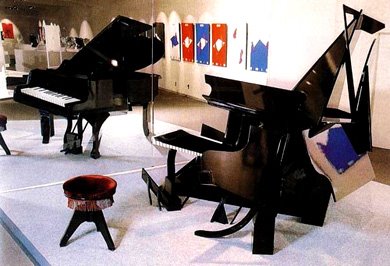 A collection of piano parts rebuilt by illusion artist Shigeo Fukuda into a strange-looking sculpture actually resembles a piano in a mirror only if you view it from the correct angle.
Link
More illusions at Shigeo Fukuda's site
Sunday, October 15, 2006
The 43 Things piano meme
The popular website 43 Things features a list of shared goals that people who post to the site want to accomplish, kind of like Digg or Reddit, but with goals instead of news stories, the most popular of which end up on a zeitgeist page. I must confess I don't get this 43 Things thing, even though it seems to be a site that everybody links to these days. I noticed a couple of piano-related goals, including Learn to play the piano (3046 people) and practice piano more (29 people). Most amusing is what people who list wanting to practice more are listing as the things they also want to do: visit Iceland, buy a new car, and learn to sew. Honestly. I thought I was a bad procrastinator.
Friday, October 13, 2006
Broadcaster of the Year
CBC Radio picked up numerous awards at the New York Festivals Awards, including Broadcaster of the Year.
Link to cbc.ca article
Link to 2006 Radio Programming and Promotion winners press release
Link to cbc.ca article
Link to 2006 Radio Programming and Promotion winners press release
Why Music?
Last Friday's Oakville Beaver contained a brilliant article by Omar Othman, a Grade 8 student at Heritage Glen Public School. Entitled "Music does more than soothe the soul", Omar makes the case for music education as well as I've ever seen it put.
Link
Link
Wednesday, October 11, 2006
10 ways to translate song and aria texts into English
A query from one of my students on how to effectively translate song and aria texts from foreign languages to English resulted in this latest list, with links and caveats:
1. Learn the foreign language to the level that you can understand the full meaning of the words of the song. There is no substitute for really knowing the nuts and bolts of a language and applying that knowledge to the study of a song or aria, an investment that will repay the time spent many times over. Failing that, read the other nine hints...
2. Translate the song or aria word-for-word with the aid of a dictionary. This is the old school method and up until a couple of decades ago was the only way to translate. This method involves many hours of sitting with a dictionary and looking up words, tenses, and idioms, but the time spent will repay itself in the depth of knowledge that you will then be able to bring to the song, since you had to work to uncover the meaning of the original text.
3. Consult the Lied and Art Song Texts Page. The brainchild of Emily Ezust, this site was one of the first web-based art song resources since its inception in the mid-90's and has been growing ever since.
4. Consult the Aria Database. Created by Robert Glaubitz in 1996 and growing steadily since then with a large collection of searchable material.
5. Use the Fischer-Dieskau Book of Lieder . This book has been a staple of singers and pianists for the last 30 years and although it is not exhaustive, it is still one of the quickest ways to find English translations of German lieder. Also of inestimable value is Fisher-Dieskau's essay on German song that serves as the foreward to the book.
6. Use The Interpretation of French Song by Pierre Bernac. Good translations of songs of numerous French composers and commentary by Bernac are supplemented by chapters on subjects such as French lyric diction and interpretation.
7. Use an edition that comes with translations of the texts. Numerous examples abound of recent editions by publishers such as Alfred, Hal Leonard, and Frederick Harris Music that contain English translations to aid both teachers and students.
8. Find English translations on liner notes of CDs and LPs. This is still one of the best ways to find translations of hard-to-find repertoire and rarities. Liner note translations can often be better than online translations, but not as good as those done by those who start at steps 1 or 2.
9. Do a Google search. You might have to sort through a lot of sites, but chances are you'll eventually find the translation you're looking for. Or you might not.
10. Use an online translation service such as Babelfish. Web-based translation services are still in their infancy and don't often work with idioms and archaic words in the repertoire, but you'll probably get most of the text translated. For words not translated by this service, go back to step 2.
1. Learn the foreign language to the level that you can understand the full meaning of the words of the song. There is no substitute for really knowing the nuts and bolts of a language and applying that knowledge to the study of a song or aria, an investment that will repay the time spent many times over. Failing that, read the other nine hints...
2. Translate the song or aria word-for-word with the aid of a dictionary. This is the old school method and up until a couple of decades ago was the only way to translate. This method involves many hours of sitting with a dictionary and looking up words, tenses, and idioms, but the time spent will repay itself in the depth of knowledge that you will then be able to bring to the song, since you had to work to uncover the meaning of the original text.
3. Consult the Lied and Art Song Texts Page. The brainchild of Emily Ezust, this site was one of the first web-based art song resources since its inception in the mid-90's and has been growing ever since.
4. Consult the Aria Database. Created by Robert Glaubitz in 1996 and growing steadily since then with a large collection of searchable material.
5. Use the Fischer-Dieskau Book of Lieder
. This book has been a staple of singers and pianists for the last 30 years and although it is not exhaustive, it is still one of the quickest ways to find English translations of German lieder. Also of inestimable value is Fisher-Dieskau's essay on German song that serves as the foreward to the book.6. Use The Interpretation of French Song
by Pierre Bernac. Good translations of songs of numerous French composers and commentary by Bernac are supplemented by chapters on subjects such as French lyric diction and interpretation.7. Use an edition that comes with translations of the texts. Numerous examples abound of recent editions by publishers such as Alfred, Hal Leonard, and Frederick Harris Music that contain English translations to aid both teachers and students.
8. Find English translations on liner notes of CDs and LPs. This is still one of the best ways to find translations of hard-to-find repertoire and rarities. Liner note translations can often be better than online translations, but not as good as those done by those who start at steps 1 or 2.
9. Do a Google search. You might have to sort through a lot of sites, but chances are you'll eventually find the translation you're looking for. Or you might not.
10. Use an online translation service such as Babelfish. Web-based translation services are still in their infancy and don't often work with idioms and archaic words in the repertoire, but you'll probably get most of the text translated. For words not translated by this service, go back to step 2.

Saturday, October 07, 2006
Another great opera resource
This morning when trying to find an English translation of a passage from Nabucco, I stumbled upon Opera Guide, a site I hadn't yet encountered. Available in English and German as part of Kernkonzepte's Impresario site, Opera Guide contains a huge listing of synopses and libretti (many of them translated into English) arranged alphabetically by composer. Opera Online is the paid tier of the Opera Guide service containing sheet music, MIDI files, and parallel texts payable via PayPal donation in order to keep the site entirely non-commercial.
You can find a permanent link to Opera Guide on the off-site resouces section of the sidebar.
Link to Opera Guide
Link to Opera Online
Link to Impresario portal
Link to KernKonzepte
You can find a permanent link to Opera Guide on the off-site resouces section of the sidebar.
Link to Opera Guide
Link to Opera Online
Link to Impresario portal
Link to KernKonzepte
Tuesday, October 03, 2006
10 ways for collaborative pianists to build language skills
1. Be able to translate a song or aria from the original language into your own language. This is step 1 for the process of learning vocal music of any style and genre. If you know what the song is about on a detailed level, you will already be able to play or sing it at a higher level.
2. Write the translation above the vocal line in the score. This way, you can learn the meaning of the words and get them into your bones through osmosis by having them written in such an obvious place.
3. Learn the International Phonetic Alphabet. There isn't always a one-to-one correspondence between the sounds of a language and its IPA symbol, but knowledge of IPA does provide a common ground that allows the sounds of language to be talked about objectively.
4. Learn the basics of lyric diction for the languages central to the repertoire. Italian, German, French, and English, are the languages most encountered. Other languages encountered include Russian, Latin, Spanish, and Czech.
5. Learn the basics of the langages central to the repertoire. Nothing beats knowing the building blocks of how a language works and getting a good start on the road to fluency.
6. Become fluent in the languages central to the repertoire. Not every collaborative pianist will spend time achieving this difficult and time-consuming skill. The best way: spend some time in a country where the language is spoken either as a visitor, student or professional. Being able to speak and talk about a language with the experience of fluency will repay many times over the time spent in acquiring it.
7. Be able to talk about poetry and poetics. Knowledge of how poetic language is constructed from the ground up can greatly help the transition from accompanist to vocal coach. One of the things that singers need from coaches is a way of understanding the techniques of poetic languagte as a route to motivating the performance. I recommend Mary Kinzie's excellent A Poet's Guide to Poetry as one of the best ways of learning the tools of the poetic trade.
8. Be able to talk about librettos. Learn not just the text of the aria or scene, but the text of the entire work. Libretto-writing is an art closely related to playwriting, but different in many significant ways.
9. Learn song cycles in their entirety. The time spent will more than reward you in the knowledge gained from such a process.
10. Learn operas in their entirety. Ditto.
2. Write the translation above the vocal line in the score. This way, you can learn the meaning of the words and get them into your bones through osmosis by having them written in such an obvious place.
3. Learn the International Phonetic Alphabet. There isn't always a one-to-one correspondence between the sounds of a language and its IPA symbol, but knowledge of IPA does provide a common ground that allows the sounds of language to be talked about objectively.
4. Learn the basics of lyric diction for the languages central to the repertoire. Italian, German, French, and English, are the languages most encountered. Other languages encountered include Russian, Latin, Spanish, and Czech.
5. Learn the basics of the langages central to the repertoire. Nothing beats knowing the building blocks of how a language works and getting a good start on the road to fluency.
6. Become fluent in the languages central to the repertoire. Not every collaborative pianist will spend time achieving this difficult and time-consuming skill. The best way: spend some time in a country where the language is spoken either as a visitor, student or professional. Being able to speak and talk about a language with the experience of fluency will repay many times over the time spent in acquiring it.
7. Be able to talk about poetry and poetics. Knowledge of how poetic language is constructed from the ground up can greatly help the transition from accompanist to vocal coach. One of the things that singers need from coaches is a way of understanding the techniques of poetic languagte as a route to motivating the performance. I recommend Mary Kinzie's excellent A Poet's Guide to Poetry as one of the best ways of learning the tools of the poetic trade.
8. Be able to talk about librettos. Learn not just the text of the aria or scene, but the text of the entire work. Libretto-writing is an art closely related to playwriting, but different in many significant ways.
9. Learn song cycles in their entirety. The time spent will more than reward you in the knowledge gained from such a process.
10. Learn operas in their entirety. Ditto.
Monday, October 02, 2006
Recital with Ashley Bedard on Wednesday
Here is the program for the recital I will be playing with Ashley Bedard this Wednesday:
Music for a While (Purcell)
An die Musik (Schubert)
Chanson triste (Duparc)
from Fiançailles pour rire (Poulenc)
La dame d’André
Violon
Fleurs
Jewel Aria from Faust (Gounod)
from Gypsy Songs (Dvorak)
Kdyz mne stara matka
Struna naladena
Siroke rukavy
Dejte klec jestrabu
Vilja (Lehar)
Come in quest’aura bruna from Simon Boccanegra (Verdi)
Ave Maria from Otello
Cäcilie (R. Strauss)
Ashley Bedard, soprano
Christopher Foley, piano
Princess Margaret Hospital Mezzanine
610 University Avenue
12pm October 2, 2006
Free Admission
Christopher Foley, piano
Princess Margaret Hospital Mezzanine
610 University Avenue
12pm October 2, 2006
Free Admission
Music for a While (Purcell)
An die Musik (Schubert)
Chanson triste (Duparc)
from Fiançailles pour rire (Poulenc)
La dame d’André
Violon
Fleurs
Jewel Aria from Faust (Gounod)
from Gypsy Songs (Dvorak)
Kdyz mne stara matka
Struna naladena
Siroke rukavy
Dejte klec jestrabu
Vilja (Lehar)
Come in quest’aura bruna from Simon Boccanegra (Verdi)
Ave Maria from Otello
Cäcilie (R. Strauss)
Subscribe to:
Posts (Atom)