Just in time for Hallowe'en, here's a video with the pianist credited but not the soloist: Mendelssohn's Hexenlied arranged for violin and piano, played by pianist Sebastian Knauer and a mystery violinist...
Friday, October 31, 2008

Restoring a Piano, Step by Step
Here's a fascinating documentary about the restoration process of a 1927 Mason & Hamlin piano, courtesy of Lindeblad Piano Restoration.
(Thanks, Bhaskar!)
(Thanks, Bhaskar!)
Thursday, October 30, 2008
8 Ways to Improve Your Enjoyment of the Piano Through Playing Christmas Music
 As the holiday season approaches, the perfect season for developing keyboard skills in unexpected ways also approaches through playing Christmas piano music. Pianists often miss out on much of the fun and growth that playing festive holiday rep can bring. Here are some of the benefits from learning and playing selections from this huge body of repertoire and how you can accomplish them:
1. Super-size your repertoire. Many pianists at the intermediate and senior level in preparation for exams, recitals, competitions, and college auditions, only work on a handful of pieces, missing out on many of the lessons that learning a larger repertoire can bring. When you delve into the world of Christmas music, you find that there is a huge depth of carols and songs that form the corpus of the Western tradition, most of which are not too difficult to play. Why learn one Christmas carol when you can learn 20 of them?
2. Enjoy the fun of music-making with others. Christmas is a prime time to discover the joy of leading friends and family in song. The usual separation of performer and audience is gone in much Christmas music-making. If you play, they will sing!
3. Learn how to play from a fake book. One of the most gratifying keyboard skills (and one that most classical pianists have turned their backs on) is the ability to play the accompaniment of a melody from popular chord notation in a fake book. Learning the language of pop chords can be tricky, but an easy path into this skill is through learning to add chords to melodies you already know. Once you've got the hang of it, you can add your own accompaniment style and personal vibe.
4. Learn how to transpose. You're playing carols at a family Christmas party and after the first carol, someone complains: "Uh, I can't sing that high. Can we sing it in a lower key?" This is a prime opportunity to learn the lost art of transposition. What helps here as well is already knowing the melody line, and learning the ear, sight, and tactile clues that can help you to develope one of the core skills of jazz pianists, and one of the most neglected skills of classical pianists.
5. Learn to sightread. So much Christmas music, so little time. What do you do if someone plunks Christmas music in front of you that you've never seen in a roomful of merrymaking family members? Why, you sightread, of course. And there's no better place to learn to sightread than in festive situations, with the pressure off. Those skills your piano teacher taught you, which seemed so theoretical and arcane at your lesson the other day, suddenly come back with a vengeance to assist you becoming being the hero of the evening, and a keyboard skills ninja to boot.
6. Learn correct rhythm. Here's another skill to be learned in the heat of battle: that a steady pulse is an integral part of keeping everyone together in group singing situations. And what better way to keep them together than by playing with a steady and reliable beat. The flipside, of course, is that any lack of rhythmic pulse will leave the singers in a swirling cacophony of disarray and headed to the bar for another shot of rum and eggnog.
7. Drastically reduce performance anxiety. Many performers experience crippling cases of nerves in the minutes and hours before performances. One of the best ways to solve this common malady is to both perform more and perform in positive, low-stress situations. The lessons learned in playing carols for a roomful of family members on Christmas Eve can easily be brought into the concert hall, along with a realization that the social aspects of music-making are what make it such a wonderful way to connect with people.
8. Develop functional keyboard skills. Playing piano isn't just about preparing music for your lessons, doing exams, and winning competitions. It's also about being able to bring spontaneous enjoyment to people through one of the most social of all musical instruments, and learning the skills that can bring a lifetime of enjoyment to yourself and others.
Below are links to some useful Christmas music collections. Be aware that all Christmas music at Sheet Music Plus is discounted 20% until November 20, 2008, so make sure you order early enough to take advantage of these prices.
 | Reader"s Digest Merry Christmas Songbook For voice, piano and guitar chords. P/V/C Mixed Folio; Piano/Vocal/Chords. Reader"s Digest Publications. Easy-to-play arrangements and lyrics for more than 100 songs. Christmas and Holiday. SMP Level 4 (Intermediate). Songbook, performance CD (23 tracks) and lyric booklet. Vocal melody, piano accompaniment, lyrics, chord names and guitar chord diagrams. 255 pages. Published by Alfred Music Publishing (AP.48-0762108681) ...more info |
 | Charlie Brown Christmas By Vince Guaraldi. For solo piano. Piano Solo Songbook. Jazz, TV and Christmas. SMP Level 7 (Late Intermediate). Songbook. Chord names and illustrations (does not include words to the songs). 40 pages. Published by Hal Leonard (HL.313176) ...more info |
 | Level 1 - Christmas Book (Piano Adventures®). By Nancy Faber and Randall Faber. For Piano. Faber Piano Adventures®. Christmas. 1. Softcover. 20 pages. Faber Music #FF1138. Published by Faber Music (HL.420206) ...more info |
 | Sleigh Ride (Piano, Four-Hands) By Leroy Anderson (1908-1975). Arranged by Michael Edwards. For piano four-hands. Duet or Duo; Piano Duet (1 Piano, 4 Hands). Late Intermediate level piece for the Piano Duet event with the National Federation of Music Clubs (NFMC) Festivals Bulletin 2008-2009-2010. Traditional Pop and Christmas. SMP Level 8 (Early Advanced). Single. Primo and secondo parts. 12 pages. Published by Alfred Music Publishing (AP.26544) ...more info |
 | My First Piano Adventure® Christmas - Book A (Pre-Reading). By Nancy Faber and Randall Faber. Faber Piano Adventures®. Pre-Reading. Softcover. 16 pages. Faber Music #FF3001. Published by Faber Music (HL.1471) ...more info |
Wednesday, October 29, 2008
Poll: Which of the following is the most important in building your performance career?
From an ongoing discussion about career-building with Liz, I've just created a sidebar poll that asks the question:
Which of the following is the most important in building your performing career?
Update 11/7:
Here are the results of the poll from the 26 people who responded:
Related articles:
10 Posts in 10 Hours #9: Freelancing Resources
10 Posts in 10 Hours #3: Hive Call for Career Options Updates
Getting Started as a Rehearsal Pianist
How to Get Work as a Freelance Collaborative Pianist
Required and Preferred Skills for the Collaborative Pianist
Which of the following is the most important in building your performing career?
- Practicing
- Networking
- Promotional materials
- Recording a CD
- Building a website
Update 11/7:
Here are the results of the poll from the 26 people who responded:
- Practicing 7 (26%)
- Networking 18 (69%)
- Promotional Material 1 (3%)
Related articles:
10 Posts in 10 Hours #9: Freelancing Resources
10 Posts in 10 Hours #3: Hive Call for Career Options Updates
Getting Started as a Rehearsal Pianist
How to Get Work as a Freelance Collaborative Pianist
Required and Preferred Skills for the Collaborative Pianist
Monday, October 27, 2008
Makeovers and Marketing for Classical Musicians
 Gone are the days when a good education, recording, resumé, and a few phone calls were enough to get one's foot in the door in the classical music world. We're living in times when it's not only how great a performer or teacher you are, but how you appear visually, what your website shows about you, how your name shows up on search engines, and how you brand yourself.
Here are some of the questions I hear on a regular basis from emerging classical artists:
-Should I get my friend to do my promo shots or should I hire a professional photographer?
-What clothes should I wear for my photo shoot?
-I haven't done that much. How do I get my bio looking as good as everyone else's?
-How do I get a website going if I know nothing about technology?
-What's a press release and how do I write one?
-Should I get an agent or a publicist?
If these issues scare the hell out of you, you have only to wait until October 31 for the launch of LIZPR, a PR company that specializes in dressing up and marketing classical musicians. Here's the full press release:
Monday, October 27, 2008Best of luck to Liz, who is also a dedicated CPB reader and commenter. For those outside the Toronto area, there is a lot of work that Liz can do for you via email (press releases, bios), but for the full fashion and image makeover, you'll probably need to come out to Toronto for a visit...
TORONTO, ONTARIO – Publicist Liz Parker has made a new mark in music world with the launch of her own business website: lizpr.com. LIZPR creates great press kits and lessons in fashion for the classical musicians who need them.
Armed with a decade’s worth of experience in major orchestra publicity with the Toronto and Vancouver Symphonies, and serving for two years as Publicity Manager at the Corporation of Massey Hall and Roy Thomson Hall, Liz has decided to take on private clients.
lizpr.com launches on Halloween. “I chose to specialise in press kits and image consulting for performers,” explains Liz. “It’s an essential part of public relations that I love to do. Press releases and coordinating media interviews is my day job. LIZPR is my favourite part of what I do, which is creating press kits and helping clients pick the right outfits for photo shoots. Wearing the right thing for photos or to events is important. I’m really excited combining everything I’m crazy about: writing and styling musicians so they look as polished as possible. They are performers. They’ve GOT to look good!”
Liz admits to being obsessed with makeover shows. “People may consider me shallow, and they would be mistaken. It’s not just about your appearance. It’s how your image can influence your attitude about yourself and your career. Looking the part of a musician isn’t exclusive to being onstage. Offstage you need to look put-together too. Musicians get to indulge in more flair because of their creative fields. I love it!”
She firmly believes that most musicians sell themselves short and need to raise their game. “Invest in a good bio and professional photography. I’ve seen way too many amateur press kits over the years. The pay-off will be worth the professional investment. Don’t turn off the very people who can help you advance your career,” Liz warns.
Liz Parker grew up in Vancouver in a family stuffed with pianos. The house was a rotating door of piano and theory students. After achieving the gold medal for the highest mark in Canada at age 15 from the Royal Conservatory of Toronto for piano performance, Liz received her Bachelor of Music from the University of British Columbia and literally talked her way through a Broadcast Radio diploma at the British Columbia Institute of Technology. After a radio career that included producing a talk show, interviewing musicians, cueing CBC’s Jurgen Gothe (who even looked up to be polite), everything clicked into place when she became a publicist.
Based in the Fashion District (natch) in Toronto, Liz loves everything about music, food, fashion, shopping, and egging people on to follow their bliss.
For more information, please visit www.lizpr.com as of October 31st, 2008!
Classical Music's First Recordings....Found At Last
Daniel Wakin reports in the New York Times that a fairly large trove of early Edison phonograph cylinders has been uncovered in Russia, with some of the earliest known examples of classical recordings:
The NY Times Multimedia Page can be found here.
The entire collection is slated to be released shortly by Marston Records.
According to Marston, the cylinders contain the earliest existing recordings of works by Bach, Wagner, Verdi, Chopin, Schumann and others. The performers include several noted composer-pianists: Sergei Taneyev, a pupil of Tchaikovsky’s who played the premiere of his Second Concerto; Anton Arensky, playing his much-loved Piano Trio No. 1 in D minor just months after it was written; and Paul Pabst, a Liszt pupil and dedicatee of pieces by Tchaikovsky and Rachmaninoff. They also include the legendary pianist Josef Hofmann in his first known recordings and singers who performed in the premieres of operas by Tchaikovsky and Rimsky-Korsakov. Some 22 of the artists, well known in their day, have not been represented on recordings until now, including Taneyev.The NYT also has put together a multimedia page with samples from the found recordings. In spite of the grainy quality of the cylinder-to-digital transfers, you can still get a decent feel for what musicians sounded like in that era. I particularly enjoyed the piano playing of Josef Hofmann and Anton Arensky. Then again, the singers....well, it only reinforces the stereotype that most singers 100 years ago would never work these days. Louisa Margaret Nicholson aka Madamoiselle Nikita has some flexibility, but those vibrato issues and the straight tone on the last note would not endear her to many current listeners. Maria Klimentova-Muromtzeva shows a bit more consistency, but the core of sound carried by the cylinder sounds little more than amateurish to my ears of 2008. Still, these recordings are a valuable tool to both collectors, performers, and educators, sho will have a lot to discover by donning the ears of 1900.
The NY Times Multimedia Page can be found here.
The entire collection is slated to be released shortly by Marston Records.
Saturday, October 25, 2008
Guitar Hero, DDR, and Music Education
I've just been featured in a Toronto Star article on the relationship of musical video games (such as Guitar Hero and DDR) to music education. Raju Madhar's Games Mould Future Musicians is sure to raise the ire of many a traditional musician. Here's what I said in the interview:
Your thoughts?
Dr. Christopher Foley has assigned video games as homework as part of his job as head of the voice department and piano teacher at the Conservatory School at the Royal Conservatory of Music. "The thing about those games is that while they don't directly teach musical skills, they teach a lot of indirect skills," he says. "The main one that I think is useful is that you have to internalize the rhythm, and something like DDR (Konami's Dance Dance Revolution) teaches the physicality of rhythm. By having to learn the dance moves, it's not something you learn intellectually, it's something you learn physically, and that's something you can bring to any instrument.
As for Guitar Hero, "what it does teach you is the eye-hand co-ordination and being able to integrate seeing and hearing, which is really important to music. ...There is a little bit of (music) theory in these games, too, in that you have to figure out their specific musical notation, whether it's the arrows in DDR or the coloured blips on Guitar Hero."
Another indirect effect of these games – and other video games including role-playing games – is that they help kids develop dedication and work ethic as they learn how to play and improve, said Foley.
"That way of thinking works very nicely with the whole idea of work ethic; that musicians need to develop, that it's not something you do once a week, it's something that you become totally obsessed by, that you have to work on it every single day."
Your thoughts?
Friday, October 24, 2008
10 Posts in 10 Hours #10: RCO Offers Free Downloads Until November 24
Via Classical Convert, the Royal Concertgebouw Orchestra in conjunction with Radio 4 is offering free downloads of 10 well-known symphonies until November 24. After entering some personal data and responding to a confirmation email, away you go with free recordings of Schuber 8, Beethoven 2, Mendelssohn 4, Franck D-, Mahler 1, Dvorak 8, Saint-Saëns 3, Sibelius 2, Bruckner 8, and Brahms 2. Happy 120th, RCO!
Here's a recent video of the RCO with Bernard Haitink playing the last movement of Mahler's 4th Symphony. Christine Schafer is the soprano soloist.
Here's a recent video of the RCO with Bernard Haitink playing the last movement of Mahler's 4th Symphony. Christine Schafer is the soprano soloist.
10 Posts in 10 Hours #9: Freelancing Resources
How the economy is changing these days...here are some links to help you stay abreast and benefit from the shifting landscape:
-Cinncinnati-based pianist and teacher Joshua Nemith continues his series on how to retool your musical skill set with Freelancing in the "New" Economy series Part 2. This time around, Joshua looks at getting a church job, pursuing a sessional faculty position, learning other keyboard instruments and musical styles, as well as the ever-present possibility of changing careers. As an aside to Joshua's last point, I know an awful lot of musicians who have in the last year gone on to Teacher's College in order to pursue teaching at either elementary or secondary schools. With K-12 positions (at least in Canada) offering better pay, benefits, job security, and satisfaction than most college positions, who can blame them?
-Worried about freelancing in a changing economic climate? Why not simply become a better freelancer? Freelance Switch has a huge list of 50+ Ways to Improve Your Productivity as a Freelancer. From having a clear set of objectives to cutting down distractions and utilizing better tools, there's something in Steven Snell's list for everyone.
-For a look at how arts organizations are navigating economic change, take a look at Chamber Music Today's Performing Arts, Free-Market Failure, and New Institutional Economics:
Should we change our ticket prices or booking fees this year? How much discounting or comping should we do to get more attendee butts in seats and, if we do more than we’ve done in the past, will that help or hurt sales of regular tickets or subscriptions? If our ensemble does pro bono or deeply-discounted performances in some cities, will that help or hurt our bookings for bigger-margin gigs elsewhere?
How have your freelancing experiences changed in the last few months, if at all?
10 Posts in 10 Hours #8: Studio Policies Galore
Studio policies--they always seem to be a work in progress, always being tweaked, always with grey areas, but an integral way to run a studio of any size, define expectations, and lay down the law if need be. Susan Todd has created a dedicated studio policy website taken from the archives of the Pno-Ped-L mailing list. Take a look at them, extract ideas and formats that work for your studio, fine-tune, and revise!
More articles:
8 Ways to Improve Your Marks in RCM/NMCP Piano Examinations
9 Ways to Connect Online With Other Pianists
10 Ways to Compete With the Lowest-priced Piano Teachers in Town
10 Posts in 10 Hours #7: Canadian and American Orchestral Websites Compared
One of the most professionally written and designed classical music blogs over the last few years has been Adaptistration by Drew McManus. Those in the orchestral field should definitely check out his rankings of both American and Canadian orchestra websites. Drew has done an incredible amount of analysis, taking into account elements such as ease of navigation, biographical information on musicians, as well as the ability of audiences to both book tickets and donate online. He has put together rankings from both countries to create comparisons between orchestral websites in both countries. And guess what? It doesn't look too good for those websites north of 49, with only two orchestras receiving a mark above a C+. Spoiler alert: the three highest rated orchestral sites in North America are those from Chicago, Nashville, and Edmonton.
10 Posts in 10 Hours #6: Two Composers of New Canadian Art Song
One of the hottest new classical music blogs in Canada of late has been From the voice of..., from the pen of soprano Elizabeth McDonald on the Queen's University faculty. A recent post about Martha Hill Duncan and Maria Molinari highlights the contributions of these women to the field of Canadian art song for developing singers, not traditionally an important niche market for composers, but one that can potentialy fill a tremendous demand throughout Canada.
Interested in knowing how new works for the voice are created? Read Creating Opera From Scratch at the 2008 Tapestry Composer/Librettist Laboratory.
Interested in knowing how new works for the voice are created? Read Creating Opera From Scratch at the 2008 Tapestry Composer/Librettist Laboratory.
10 Posts in 10 Hours #5: Auditions Schmauditions
Here are a few articles from the last while on the subject of auditioning for singers:
First of all, a first person account of going through the process from an aspiring choral singer on a mission to infiltrate her favorite school of music:
Finally, my name was called and it was time to go in. I was surprised by the number of people in the room. They were a mix of grad students and professors, probably ten or eleven people in all. I brought my music over to the accompanist, realizing as I did so that it had come off the copier slightly askew and that it was hard to tell what a couple of notes were. "I hope this is readable," I apologized as I handed it to him.
Erica Hansen in the Deseret News hosted a panel of theatre experts in Here are some audition tips to get you a callback instead of a brushoff. Although the article is from the musical theatre point of view, there is still plenty of great information for classical singers as well.
Kim Witman on Wolf Trap Opera has recently written an incredible amount of information on auditions, much of it in response to reader inquiries. Articles worth a gander include Reruns Welcome, In the Audition Room, Naked Toes and Aria Advice, Opening the Screen Door, and More Aria Questions and Audition Guidelines. I owe a tremendous debt of gratitude to Kim for being the first person ever to link to the CPB in November 2005.
More audition stuff on CPB:
Audition Strategies for Singers
Am I Too Soft?
Professional-level Singing and That Certain Je ne said quoi
The 2008 Aria Frequency List
More audition stuff on CPB:
Audition Strategies for Singers
Am I Too Soft?
Professional-level Singing and That Certain Je ne said quoi
The 2008 Aria Frequency List
10 Posts in 10 Hours #4: Koldofsky Benefit Memorial Recital
On Tuesday, October 28th at 7:30pm, the University of Southern California's Thornton School of Music will be presenting the annual Koldofsky Benefit Memorial Recital, an evening dedicated to the legacy and memory of the great Gwendolyn Koldofsky, who pioneered the world's first Master of Music degree in Piano Accompanying. On the program will be Kevin Fitz-Gerald, Alan Smith, Rod Gilfry, and a selection of special musical guests. Suggested donation is $25 with proceeds to benefit Keyboard Collaborative Arts at USC.
More Madame K mentions on CPB:
Read her famous six-step method for learning a song in Some Ideas on How to Learn a Song or Aria
Rare Footage of Gwendolyn Koldofsky Playing in Lotte Lehmann Master Class
Erlkönig Hacks for the Schubertian Pianist
Erlkönig Hacks for the Schubertian Pianist
10 Posts in 10 Hours #3: Hive Call for Career Options Updates
One of the things I've always been fascinated about in my field is the nature of its work, and how musicians are always finding new and unexpected ways to both make a living and satisfy their muses. One of the most popular pages on this site is the large list of Career Options in Collaborative Piano, covering everything from life in opera companies, to universities, to freelance work, to admistration.
Take a look at the Career Options list. In light of the changing nature of professional life, influenced as it is by factors such as technology and the overall health of the economy, are there any other career options that you are noticing either in your own work or the work of your colleagues that need to be mentioned? Bear in mind that the original posting was created nearly 3 years ago, and a lot of things have changed since then. Leave a comment below or send me a quick email (collaborative piano [at] gmail dot com) describing any work niches in our field that are worth a mention, as well as observations or anecdotes that you would like to share with the CPB readership.
10 Posts in 10 Hours #2: Guerrilla Musical Theatre Performance in London's Stansted Airport
What a surprise it must have been for the unsuspecting Stansted Airport travellers in this viral video. I'm not crazy about the pastiche style of the music (nor am I too excited to see it's a thinly disguised ad for an online travel agency), but it's always refreshing to hear music taken out of its traditional venues and taken to places one doesn't usually associate with live theatre.
More musical performances in unexpected places:
10 Posts in 10 Hours #1: The 5 Browns Play Stravinsky--in the Desert
It's dawn in the Bonneville Salt Flats. The sun rises over a massive salt pan incapable of growing plant life. What a perfect locale for the music of Stravinsky--here's a video of the 5 Browns playing an excerpt from Stavinsky's The Firebird, arranged for 5 pianos.
The 5 Browns previously on CPB: Not Your Average Piano Quintet
The 5 Browns previously on CPB: Not Your Average Piano Quintet
Thursday, October 23, 2008
Starting Friday at 1pm: 10 Posts in 10 Hours
Friday afternoon starting at 1pm EDT I will be posting an article every hour for 10 hours on a variety of subjects near and dear to the hearts of CPB readers. Stay tuned...
Wednesday, October 22, 2008
Judy Kaye and Donald Corren in Souvenir at Baltimore's Centerstage
Souvenir is a musical comedy about the life of Florence Foster Jenkins, as narrated by Cosme McMoon, her pianist:
Hilariously funny and touchingly sincere, Souvenir is a fantasia on the wonders of illusion and delusion, by playwright Stephen Temperley. The theatrical duet with music follows the incredible-but-true story of real-life Manhattan socialite Florence Foster Jenkins, as told by her accompanist Cosmé McMoon. Jenkins, an eccentric, self-styled diva, won renown in the Thirties and Forties (and cult status since) for sharing her singular genius in lavish recitals--despite (or maybe because of) her astonishing lack of any musical ability.Baltimore's Centerstage has just announced that Souvenir will be running from April 24 to May 24, 2009, starring Judy Kaye as FFJ and Donald Corren as Cosme McMoon aka Edwin McArthur. Souvenir will definitely be a show to see for those in the Baltimore area.
More articles on Florence Foster Jenkins and Cosme McMoon:
Bang on a Can All-Stars Seek Pianist
Here's a once-in-a-lifetime opportunity for a pianist in the NYC area to get on board with one of the top new music ensembles on the planet: the Bang on a Can All-Stars are looking for a new pianist. Sequenza21/ has the complete job listing posted and applications are due November 14.
Below is a video of the Bang on a Can All-Stars with Thurston Moore (of Sonic Youth fame) playing Moore's Stroking Piece:
Below is a video of the Bang on a Can All-Stars with Thurston Moore (of Sonic Youth fame) playing Moore's Stroking Piece:
Tuesday, October 21, 2008
100,000th Visitor to the Collaborative Piano Blog
The Collaborative Piano Blog just had its 100,000th visitor today (according to my Sitemeter account), on a direct visit (either via browser bookmark or typed-in url) from someone at Queen's University in Kingston, Ontario.
Of course, this milestone is somewhat less important than it would have been a few years ago. Site engagement is no longer measurable merely by visitors to the site. The CPB has over 300 subcribers via RSS feed, and feed-reading traffic (via Google Reader, Bloglines, Netvibes, and email) now outstrips site traffic on most days.
Monday, October 20, 2008
Music Catch, a Flash-based Game
Check out Music Catch on Kongregate. It's a simple little game (yellow is good, red is bad, purple is awesome), but the music is quite memorable and strangely addictive. My highest score to date is 1,085,918 1,890,989 2,409,490.
Répétiteur -----------> Conductor
I have often heard it said that répétiteurs have some of the best entrées into the conducting world. Why? Because of their ability to read from score, play from score, and work with both soloists and large groups of musicians. Witness the appointment of David Angus to the position of Music Director at Glimmerglass Opera. Angus got his start as a répétiteur for Opera North, from which he launched his conducting career.
See also:
Degree Programs in Collaborative Piano (more updates and links coming soon)
An Interview With Cosme McMoon
Oh, the wonders of search engines. On a search the other day for more information on the (in)famous socialite/soprano Florence Foster Jenkins, I chanced upon a fascinating wealth of information regarding Cosme McMoon, FFJ's pianist.
so woefully bereft of talent with such a unique persona:
terrors delights of Florence Foster Jenkins', er, unforgettable voice should definitely check out The Glory (????) of the Human Voice , otherwise have a gander at this past post with FFJ's Queen of the Night aria.
I had always known incorrectly assumed (see here) that "Cosme McMoon" was a nom de plume (nom de klavier?) of a well-known New York pianist of the time. However, at the end of an interview transcript from WCLV Cleveland (which was copied to a mailing list that somehow ended up on the archives of the UC Davis site) , Paul Moor states that Cosme McMoon was actually the well-known pianist Edwin McArthur, also known for his work with Kirsten Flagstad. From Moor's account:
I'd heard before that McArthur had played for Mme Jenkins at the beginning of his career, but had never taken it seriously. I can only assume that at the time he, as any musician can understand, simply needed the scratch. The discovery of Cosmé McMoon's true identity set me on fire to get into contact with him, and ask him some probing psychological questions about her rare disorder. Unfortunately, I learned from Grove's Dictionary of Music and Musicians that Edwin McArthur had already died, at the age of 79, on February 2, 1987. I still marvel at the sublime serenity of his facial muscles the only time I heard him and Mme Jenkins together. At that time I had the feeling that nothing short of an atomic explosion would have ruffled his extraordinary aplomb.The interview with McArthur/McMoon is fascinating, and sheds light on the FFJ phenomenon and how the New York audiences were able to create the mystique of a great artist in a singer
Q. In what way was the audience able to contain itself, or to maintain some semblance of approval during all this, Mr. McMoon?You can read the entire interview here. Those eager to sample the
A. Why, there wasn't any question of semblance of approval, because they approved of it wholeheartedly, but the audience nearly always tried not to hurt her feelings by outright laughing, so they developed a convention that whenever she came to a particularly excruciating discord or something like that, where they had to laugh, they burst into these salvos of applause and whistles and the noise was so great that they could laugh at liberty.
, otherwise have a gander at this past post with FFJ's Queen of the Night aria.Sunday, October 19, 2008
You're Playing Where?
It's getting harder to hear the current crop of European soloists in North American concert halls, according to David Patrick Stearns in the Philadephia Enquirer. Those that do are often making debuts in non-traditional venues. Israeli pianist David Greilsammer is no exception:
Rather than waiting for a U.S. presenter to take a chance on his trademark program of John Cage, Johannes Brahms and Gyorgy Ligeti, Greilsammer returned to New York last month at the New York City cabaret Le Poisson Rouge on Bleecker Street in the West Village - Steinway and all. Not only were the 300-odd seats filled, but also the audience went home with free promotional CDs.Sounds like classical promoters might be starting to think like their counterparts in the indie world.
Saturday, October 18, 2008
Sarah Palin/Katie Couric Interview, Set to Music
Henry Hey has created a piano part to a portion of an interview between Katie Couric and Sarah Palin. View the result here:
(Via Deceptively Simple)
(Via Deceptively Simple)
Evgeny Kissin, Collaborative Artist
From a John Woods review of a recent art song recital by baritone Dimitry Hvorostovsky and pianist Evgeny Kissin at the Barbican in London:
Kissin's remarkable skill as a pianist gave him access to an extremely wide dynamic range. This meant not only delicate piannissimi, but also, of course, massive waves of sound. These were thrilling and appropriate at times, for instance in Rachmaninov's justly famous 'Vesenniye vody', but I felt he belied his relative lack of experience as an accompanist in not always recognising where it would have been preferable to keep things a little less explosive. This applied particularly to the group of Medtner songs after the interval. As one would expect, given that Medtner wrote the songs with his own considerable skills as a pianist in mind, the piano writing is very full, and seems to exploit the central register of the piano particularly richly. This coincides closely with the vocal tessitura of these songs when undertaken by a baritone. Had Kissin been accompanying a mezzo-soprano, singing an octave higher than Hvorostovsky does, there would have been no issue, but as it was, the vocal line was frequently overwhelmed in these settings.Kudos to Mr. Woods for some perceptive writing on collaborative playing that one doesn't often see in classical music criticism. Read the entire review here.
Thursday, October 16, 2008
Speedlinking - 16 October 2008
Here are some recent links from around the web:
- More classical music blogs that have recently come to my attention: Blogging the Opera, Capitol Opera's in-house production blog, Chamber Music Today, following numerous companies and stories across the chamber music world, and Chicken Scratch, the only opera blog currently known to be written by a chicken.
- You're in Washington during the roaring 20's. You need to hire the top accompanist in town. Who do you call? Why, Cecelia O'Dea, of course.
- Drew McManus has just published in the 2008 Orchestra Website Review, with info on which orchestra sites are the most navigable and audience-friendly, as well as the ones that aren't making the grade.
- Tapestry's Inside the New Works Studio has just published photos from its successful run of Opera Briefs 8.
- Its recording season. Which format do you choose for your publicity materials--CD or MP3? New Music Strategies helps you choose.
- Jake Heggie, composer and pianist. See Mark Swed's LA Times review of his recent performance with Frederica Von Stage at Santa Monica College.
Wednesday, October 15, 2008
Singer/Vlogger
An exciting new blog discovery this evening: professional auditionee, featuring Alecia Batson in her quest for employment in the opera world. In addition to writing her blog (which gets special kudos for being one of the best-looking and tricked-out Blogspot blogs around), Alecia also produces a vlog on YouTube that details more of her stories. Here is the latest episode, entitled Discovery/Admission:
Professional auditionee takes its place on the list of classical music blogs towards the bottom of the right-hand sidebar.
Professional auditionee takes its place on the list of classical music blogs towards the bottom of the right-hand sidebar.
Quote of the Day
I believe that this is where we are headed, into a world in which information is so abundant that learning how to participate in the world's knowledge conversation becomes the primary responsibility of our educational organizations, and where students learn to [become] contributors to society by actually contributing under the tutelage of wise mentors. If this is an accurate vision, then we need to help educators experience for themselves the these same transformative changes and opportunities. If we don't, we're just asking them to learn about one more technology fad in a parade of technological fads that were each supposed to remake education, and their interest reflect their "technology fatigue."--Steve Hargadon, from The Web Is Becoming a Conversation
Tuesday, October 14, 2008
Free Performance Tomorrow at the Four Seasons Centre in Toronto
Wednesday, October 15 at noon in the atrium of the Four Seasons Centre for the Performing Arts I will be performing with dancers from Opera Atelier in a free concert presentation promoting OA's upcoming production of The Abduction from the Seraglio, which opens November 8th at the Elgin Theatre. Hope to see you there! The concert starts at 12pm--make sure you get in line pretty early, as this series fills the atrium to capacity for nearly every event.
Marina Lomazov/Joseph Rackers Interview
Duo pianists Marina Lomazov and Joseph Rackers (they're also married) recently interviewed Connect Savannah's Jim Reed on their experiences performing piano duet recitals. The complete interview is available on the Connect Savannah site, of which here is a small excerpt:
Jim Reed: Do you prefer to play solo, or with additional musicians? Why or why not?You can read the entire interview here. Those in the Savannah area can also see the Lomazov/Rackers duo on Saturday night at the Savannah Concert Association.
Marina Lomazov: Each medium provides its own pitfalls and rewards. Playing solo gives you the ultimate freedom to express yourself without constrains. It’s also a lonely medium. You are by yourself for long periods of time practicing, and when you perform you bear full responsibility for the outcome. It’s a high stress environment. Playing with other people allows you to share in the excitement of music making and it provides an opportunity to learn from other musicians and get inspired by someone else’s ideas.
Jim Reed: What are the inherent challenges in playing “four-handed” piano recitals?
Joseph Rackers: The biggest challenge is trying to achieve a uniform concept of sound and articulation with your duo partner. The goal is to make a blended sound that almost sounds like one pianist rather than two.
Monday, October 13, 2008
The Same Colleagues...For 45 Years
Arnold Steinhardt, John Dalley, Michael Tree, and Peter Wiley (replacing original cellist David Soyer) are in the midst of their final concert season as the Guarneri Quartet. Janice Steinberg in the San Diego Union-Tribune writes about their journey as a quartet in advance of their upcoming performance for the La Jolla Music Society. Steinhardt on the delicate art of quartet-playing:
“Playing string quartets requires the technique and personality of a virtuoso and the fine-tuned skills of a watchmaker.” On top of that, it takes sophisticated social skills – “that balance of getting along with people but still retaining your sense of yourself.”
You can find another fascinating (albeit fictional) account of the quartet life in Vikram Seth's An Equal Music .
.
.Opera Nuova's Collaborative Piano Program

The Edmonton-based program Opera Nuova (now in its 12th year) is offering a five-week Collaborative Pianist and Vocal Coach Program from May 18 to June 22, 2009 as part of its annual early-summer roster of programs for singers and pianists at the emerging artist level. About the course:
Intensive study will focus on developing tools that pianists with advance training require to become accomplished pianist/coaches. Practical training will emphasize skills in coaching diction, cueing the singer, conducting and prompting during rehearsals, learning recitative and understanding musical and vocal traditions. In tandem with this training, pianists will have a professional experience of performing the duties of an operatic repetiteur. Each day pianists will receive classes with Michael McMahon, regular Alexander sessions, dictation class, recitative classes and weekly masterclasses focusing on accompanying artsong.The Opera Nuova faculty includes Carol and Nico Castel, Michael McMahon, Peter Dala, Stuart Hamilton, Wendy Nielson, John Fanning, Laura Loewen, and Kinza Tyrrell. Tuition for the five-week course is $800 CDN for first-time participants and $500 for those in their second year at the festival.
For more information, fill out the contact form. Pianists can also apply online for the program, and the deadline for booking auditions is October 31. Check the Opera Nuova home page for a list of audition cities and dates.
Sviatoslav Richter Skit from Monty Python
Monty Python's skit of pianist and escape artist Sviatoslav Richter playing the Tchaikovsky First Piano Concerto:
Sunday, October 12, 2008
SWCC Chorale Seeks Accompanist
The Southwestern Community College Chorale in Sylva, North Carolina is seeking an accompanist for its weekly rehearsals. Contact info and more can be found here.
Poll: Which Canadian Leader Has the Strongest Commitment Towards the Arts?
I'm running a mini-poll on the sidebar from now until Tuesday at 11pm. Regster your opinion on which of the five federal leaders you feel has the strongest commitment towards the arts.
Accompanist for Florence Foster Jenkins, a Poem by Darren Morris
In the March/April 2007 American Poetry Review, a poem by Darren Morris appeared entitled Accompanist for Florence Foster Jenkins, a meditation on the subjectivity of art. Here's a short excerpt:
They said you did not know-you knew. And I did too.
It was simply in your rusted pursuit of that elusive sparrow
who calls across the rafters of the meadow;
a sound at once so joyous and alone. Your glory
lay beneath the hearing, in the absence of sound.
You can read the entire poem here.
Below is an audio-only YouTube video of FFJ's, er, unique performace the Queen of the Night's second aria from Mozart's Magic Flute.
Saturday, October 11, 2008
Music for Ruined Pianos
 The passage of time. Space. Loneliness.
Ever wondered what a piano would sound like after being exposed to the elements for months or even years? The World Association for Ruined Piano Studies (WARPS) is a site dedicated to the unique sounds of pianos condemned to such an orphaned fate. From one of the many ruined piano stories on the site:
The Ruined Piano is a giant box of thumps, clicks, boompdidoomps, long rings, gongs, buzzes, dead ringers (notes that ring momentarily, then die completely). Notes that don't work are at least as interesting as those that do. Occasionally you push down one key and five or six others companionably go down with it, making for a surprise cluster and great swathes of harmonics singing forever.
Each Ruined Piano is utterly unique with respect to action and tuning (if we can talk of tuning at all). An F# one and a half octaves above middle C on a West Australian Ruined Piano in a semi-desert environment differs radically from the same note on a flooded piano in a studio four floors below pavement level in Prague. So approach each Ruined Piano as a new occasion for learning, letting go of last year's Sonata for the chaos, frustration and joyous confusion touched off by the wreck that's right there under your hands.
In case you're wondering what these instruments sound like, there is a full page of ruined piano recordings (many in outdoor ambient environments) that you can peruse on the WARPS site.
(Via This Blog Will Change The World; image originally uploaded by zablotny to the Perishing Pianos Pool on Flickr)
Friday, October 10, 2008
Two Important Projects for the Collaborative Piano Field
In multiple conversations over the last while, I've heard of two projects important to the field of collaborative piano that have yet to be realized. These are potentially career-making activities for the people that would like to spearhead these initiatives and no, I'm not volunteering myself for either of them.
1. A Wikipedia entry on Collaborative Piano. There is currently a lameass short entry on Accompaniment, of which here is an excerpt on how it relates to the piano:
An accompanist is one who plays an accompaniment. A number of classical pianists have become famous as accompanists rather than soloists; the best known example is probably Gerald Moore, well known as a Lieder accompanist. In some American schools, the title collaborative pianist (or collaborative artist) is replacing the title accompanist.
Um, hello? This is 2008, people. That paragraph is practically a footnote. It would be great to be able to access an entry on collaborative piano, being able to read about 1) what it is, 2) why Sam Sanders invented the term, 3) the development of the field through the late 19th and early 20th century, 4) who are the current top pianists and teachers in the field, 5) how people work as collaborative pianists. In the true spirit of the wiki, any potential article wouldn't just be the work of one person, but the contributions of the entire community over time.
2. A permanent online forum for collaborative pianists. No, the Collaborative Piano Blog is not a forum but a blog, and primarily a publishing vehicle. A forum is more of a decentralized medium in which members can forge connections, discuss issues, and post various types of content. After the 2008 MTNA Conference, which featured the work of collaborative pianists (I missed the conference but heard all about it from several sources), there was a widespread desire to continue the conversation among those in the field, and utilizing technology and the internet to achieve this goal may be the way to go. Facebook, perhaps? Several groups have sprouted up (most notably People for the Ethical Treatment of Accompanists, now with over 2200 members), but there remain some serious questions about the validity and privacy of Facebook for the depth of discussion that needs to take place, so it doesn't just become a common place for bitching and humorous anecdotes.
One possibility for such a group might be custom social network service such as Ning, currently a growing vehicle for academic-minded groups, many of which wish to retain their privacy. Whoever would start up such a group would need to 1) be either a graduate student, recognized pianist in the field, or faculty member for a collaborative piano program, 2) make decisions regarding the customizations for the community (ie. private vs. public, invitation-only vs. open to anyone), 3) have some startup funds for the roughly $20-30 per month needed to create a fully optimized ad-free environment on Ning, 4) already have at least some connections to students, professionals, and well-recognized authorities in the field, and 5) be able to lead by example in creating an environment where important issues can be discussed.
----------
Once again, I'm not volunteering myself for either of these projects, although I would be more than glad to market them once things were started up in a proper way and looked viable. However, in the spirit of the new economy, these aren't projects that one need apply for, but the kind that require someone with the courage to begin and the grit to fully implement over time. The ones to benefit will be not only people throughout the entire music field but those who come after us, who will be able to rely on trusted online guideposts to assist them as they embark on future careers.
Music and the Changing Economic Climate
 The economic viability of most of the industrialized world took a body blow this week, with banks failing, markets falling, and governments scrambling to re-establish liquidity. Lest you think that the arts is immune to this sort of activity, think again. Governments that were eager to support the arts may have to shift priorities in the coming year, private individuals that donate to the arts may reconsider their gifts in light of their own situation, and the public might be slightly less than willing to pay top dollar for concerts, subscriptions, recordings, and lessons.
How can we in the classical music field both survive and thrive in this "new" economy? Here are some links from those on the leading edge of helping artists find their way through the coming recession:
-Adaptistration's Drew McManus has created a Cultural Confidence Indicator based on the results of a continuing poll on his readership's economic outlook.
-Scott Sweeney has written a damning article about the recording industry and their complete miscalculation of the intrinsic value of music in a download culture:
When music has little or no personal value it takes more to find satisfaction. But as stated, because of easier accessibilty and storage, people will strive to have the largest collection possible. It is different from the days of vinyl, tapes and compact discs.-Joshua Nemith has just written the first part of Freelancing in the "New" Economy, a series that looks at ways that musicians , especially those without permanent positions, can "regroup and retool" their careers. Take a look at #3, which may just be a recession-proof line of work, and shows that perhaps collaborative pianists were the smart ones all along...
This is why people illegally download music. It’s not worth 1 dollar per song.
-Finally, for those eager to create and market their musical product, why bother to deal with the vestiges of a crumbling system when it's cheaper and potentially just as rewarding to handle all the steps yourself? Andrew Dubber in New Music Strategies writes about how to sell MP3's from your own website.
As we move through the coming months, I look forward to hearing your stories and comments regarding the changing landscape.
A Lunch Hour Concert Times 3, then High Holy Days
It's finally back to normal after a very busy week...
Tuesday I was at First Canadian Place in Toronto where, just a few hundred metres from where the the daily carnage was unfolding on the Toronto Stock Exchange, I performed with singers and dancers in a promotional performance for Opera Atelier's upcoming Abduction from the Seraglio that opens in a few weeks. Because of the nature of the venue (in an atrium of a busy office building), we presented a short 25 minute program not once, but three times in a row, so people could view the performance on their lunch break and then return to their computer screens to watch more of the market carnage unfold.
Then for the last two days, I've been at Temple Sinai to play at Yom Kippur services (am I ever glad I took that Advanced Keyboard Skills course at Eastman). In addition to working with Cantor Lori Salzman for the second year in a row, I also had the pleasure of playing Bruch's Kol Nidrei with Aaron Schwebel, winner of the 2008 Ben Steinberg Musical Legacy Award, and Bloch's Nigun with Jacques Israelievitch, former concertmaster of the TSO. The sevices at Temple Sinai, one of Canada's largest congregations, are quite involved during the High Holy Days--I estimated that I played at 13 hours of services in just over 24 hours.
Needless to say, I haven't been able to update for the last few days, and we now return to our regularly scheduled programming.
Sunday, October 05, 2008
Daniel Taylor's Voice of Bach
 One of the most engaging ways that Baroque music has been making inroads among listeners is through the power of the rare but opulent countertenor voice. Montreal-based Daniel Taylor has taken the journey a step further in the creation of The Theatre of Early Music, an ensemble dedicated to not just the recreation of baroque music, but the revelation of it. TEM's mission:
 "We explore the depth and substance of this choral and instrumental literature as we share our ideas and passion. The key aspect involved in the approach of the Theatre of Early Music is revelation: just as in modern-day we have restored the frescoes of Michelangelo's Sistine Chapel, so do we hope to reveal the original beauty of ancient works. Therein we hope to understand, communicate and celebrate this inspirational music."Therefore, it is wearing the twin hats of soloist and artistic director that Daniel Taylor makes his Sony BMG Masterworks debut in The Voice of Bach
, a compilation of sinfonias, arias, duets (with soprano Agnes Zsigovics) and choral numbers (with the Theatre of Early Music Choir). What sets this recording apart right away is the transparency and intimacy of texture, noticeable in the opening Sinfonia from Christ lag in Todesbanden. In the arias, Taylor's voice doesn't dominate the texture the way many voices do in many recordings of late--instead, it feels much more integrated into the texture of the ensemble as a whole. The Voice of Bach feels like a celebration of Bach's instrumental and choral writing as much as it is a celebration of Taylor's countertenor voice. The Motet from Cantata BWV 118b (O Jesu Christ meines Lebens Licht) and the chorale Vor deinen Thron tret ich hiermit showcase the TEM Choir as a vocal ensemble of the highest order--their sense of authenticity isn't just an academic exercise, but a journey into details of text, voice-leading and harmony that one can actually feel. Taylor also sings two meticulously prepared duets with Agnes Zsigovics (Wir eilen mit Schwachen and Du wahrer Gott und Davids Sohn). The only drawback about this type of recording project is that my favorite tracks (Erbarme Dich from the St. Matthew Passion, Es ist vollbracht from the St. John Passion, and two arias from the Christmas Oratorio) left me wanting to hear the dramatic and emotional scope of the complete works instead of just the highlights--I wanted the full meal instead of selected courses.
You can catch Daniel Taylor and the Theatre of Early Music in numerous venues across Canada this fall:
10/11/08 – Edmonton – University of Alberta
10/13/08 – Kelowna
10/17/08 – Quebec – Sacred Music Festival
10/19/08 – Quebec – Sacred Music Festival
10/23/08 – Quebec – Sacred Music Festival
10/24/08 – Montreal – Eglise St Irenee
10/26/08 – Dorval
10/26/08 – St. Leonard
10/27/08 – Westmount
10/30/08 – Montreal – Chapelle du Bon Pasteur
10/31/08 – Pierrefonds
12/04/08 – Kitchener
Check out the TEM concert listings for more info.
Friday, October 03, 2008
Accompanist-related Queries on Yahoo! Answers
A recent look through incoming search terms gleaned from my Sitemeter account yielded another hoard of information: people who ask questions about accompanist-related topics on the popular Yahoo! Answers site. Here are some of the questions I found:
- How do you prepare for a concert as a piano accompanist?
- How much do I pay an audition accompanist?
- How much should an accompanist charge for an out of state competition lasting several days?
- How to find an accompanist to practice with?
- What do I charge for my service as a piano accompanist?
- How can I market my skills as a rehearsal accompanist?
- What do you consider a good piano accompanist?
- Any advice for an aspiring piano accompanist?
- What are some of your embarrassing audition stories?
- How good should a concert pianist's sightreading skills be?
In case you're moved to add some answers to the above questions, a Yahoo ID is required in order to post on Yahoo! Answers.
Thursday, October 02, 2008
Become a Fan of the Collaborative Piano Blog
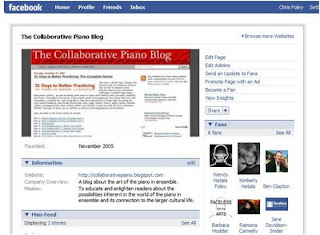 This evening I created a Facebook Page for the Collaborative Piano Blog, where you can view CPB updates and events, start and respond to discussion topics, leave comments, and more. If you're a Facebook member, you can become a fan to receive regular updates. I'm currently in the process of sending out invites to nearly 600 friends--Facebook's anti-spam measures ensure that large-scale mailings are sent out slowly rather than instantly, so existing friends might have to wait a few days while I work through the alphabet. Hope to see you there!
Quote of the Day and Some Unexpected Search Results
Sometimes when you Google a question, you don't get the answer you were looking for, but uncover all sorts of peripherally related tidbits instead. With my handy Sitemeter stats, I can keep an eye on the keywords that incoming search engine traffic sends to the CPB. From a recent search on Google:
Here are some of the search results:
Nevertheless, the question remains--why doesn't the rehearsal pianist learn the score?
Here are a few possible answers:
Why doesn't the Rehearsal Accompanist learn the score?It would appear that someone in the southern US is a little frustrated...
Here are some of the search results:
- Who's That Man With Marilyn Horne? - a 1989 New York Times article on the lives and skills of various collaborative pianists
- Like No Business I Know by Amy Dunn Williams - a look at the skills and experiences of various types of collaborative pianists
- Qualities Expected in a Choral Accompanist from a ChoralNet mailing list
- Working with the Accompanist (bottom of page 303) - a section from Kenneth Phillips' Directing the Choral Program on Google Book Search
- Piano Accompanying: Some Do's and Don't's by Tom Haug
- Most popular audition arias forum thread on Classical Singer - a 2002 forum topic that degenerates into an argument about the specialties of different types of pianists
- Finally, the CPB article that led the searcher here: Should Accompanists Charge Clients For Practice Time?
Nevertheless, the question remains--why doesn't the rehearsal pianist learn the score?
Here are a few possible answers:
- loosening the manacles chaining the pianist to the legs of the instrument may help with their pedaling.
- a pay rate in the high-mid rather than low two figures per service may help create a more positive attitude from the pianist, in spite of a slightly lower margin for management.
- providing the pianist with an original score rather than a fifth-generation photocopy is preferable for both copyright and note-reading purposes.
- putting the pianists' name in the program is not only professional, but will cause the pianist to feel that their contribution to the group is actually making a difference and cause them to play and prepare with more of a sense of engagement and purpose. Ditto on the photo and bio.
Sarah Palin Plays Flute in the 1984 Miss Alaska Pageant
Jamie of Urban Flute Project just alerted me to this video featuring Sarah Palin in the 1984 Miss Alaska competition playing flute backed by either the house orchestra for the event or a recording of one:
Subscribe to:
Posts (Atom)